


Businesses supplying digital services to customers in the UAE must understand how Value Added Tax (VAT) applies to their transactions. Whether you operate a Software as a Service (SaaS) platform, cloud-based solution, online marketplace, streaming platform, digital marketing agency, e-learning platform, or mobile application, complying with UAE VAT regulations is essential for avoiding penalties and maintaining smooth business operations.
What Is Digital Services VAT in the UAE?
Digital Services VAT UAE refers to the VAT rules applicable to electronically supplied services provided to customers in the UAE. Under the UAE VAT framework, electronic services are generally delivered over the internet or an electronic network with minimal human intervention.
The VAT treatment depends on several factors, including the customer’s location, whether the customer is VAT-registered, the place of supply, and the nature of the transaction. Businesses must assess every transaction correctly before charging VAT.
Definition of Digital Services Under UAE VAT
Digital services commonly include:
- Software as a Service (SaaS)
- Cloud computing platforms
- Software licences
- Mobile applications
- Website hosting
- Domain registration services
- Digital subscriptions
- Streaming services
- Online gaming
- E-books and downloadable publications
- Online courses and e-learning platforms
- Digital advertising
- Social media management services delivered electronically
- Digital content downloads
- AI-powered online platforms
- Subscription-based business software
Many businesses mistakenly assume that every online service follows identical VAT rules. In reality, the VAT treatment depends on the applicable place of supply rules and customer status under UAE VAT legislation.
UAE VAT Law That Applies to Electronic Services
Electronic services supplied in the UAE are governed by the UAE VAT legislation and related Executive Regulations administered by the Federal Tax Authority (FTA). Businesses must determine:
- Whether the service qualifies as an electronically supplied service.
- Where the place of supply is established.
- Whether the customer is a taxable business or an individual consumer.
- Whether UAE VAT should be charged or the Reverse Charge Mechanism applies.
- Whether the transaction should be reported in the VAT return.
Keeping proper documentation to support VAT treatment is equally important during an FTA review or audit.
Which Digital Services Are Subject to UAE VAT?
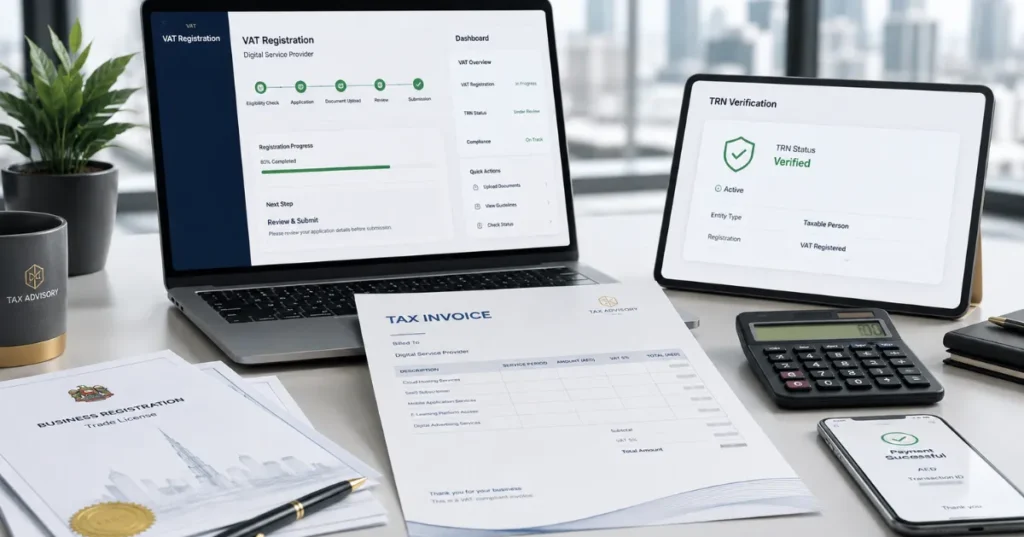
Many electronically supplied services fall within the scope of UAE VAT. Businesses should evaluate each service individually to determine the correct VAT treatment.
The following digital services are commonly subject to UAE VAT where the place of supply is the UAE:
- Software as a Service (SaaS): Subscription-based software accessed online.
- Software licensing: Sale or licensing of business software and enterprise applications.
- Mobile applications: Paid mobile apps, in-app purchases, and premium subscriptions.
- Cloud hosting: Cloud storage, cloud computing, and virtual server services.
- Website hosting: Hosting services, domain management, and server solutions.
- Streaming subscriptions: Video, music, and entertainment streaming platforms.
- Digital advertising: Online advertising campaigns and digital media placements.
- SEO services: Search engine optimisation services delivered electronically.
- Social media management: Digital campaign management and online marketing support.
- Online consulting: Consultancy services delivered primarily through digital platforms.
- E-learning platforms: Online education, training courses, and certification programmes.
- Graphic design services: Digital design files delivered electronically.
- Website development: Development services supplied through online engagement.
- AI subscription services: Artificial intelligence software subscriptions and automation platforms.
- Digital downloads: Templates, software, documents, graphics, and digital assets.
- Gaming services: Online gaming subscriptions and virtual purchases.
Businesses supplying multiple digital services should assess each revenue stream separately because different VAT treatments may apply depending on the customer and transaction.
Who Must Register for VAT When Supplying Digital Services?
VAT registration is a legal obligation for businesses that meet the mandatory registration requirements under UAE VAT legislation. Digital businesses should continuously monitor their taxable turnover to determine whether registration is required.
UAE Resident Businesses
A UAE-established business supplying taxable digital services must register for VAT once it reaches the mandatory registration threshold. Registration should be completed within the timeframe prescribed by the Federal Tax Authority.
Resident businesses should also consider voluntary registration where eligible if it supports business growth or enables recovery of input VAT.
Non-Resident Businesses
Foreign businesses supplying taxable digital services where UAE VAT registration is required may also have VAT obligations in the UAE, depending on the nature of the supply and whether another party accounts for VAT under the applicable rules.
International SaaS providers, software companies, cloud service providers, and digital platforms should review their UAE transactions carefully to determine their VAT responsibilities before supplying services to UAE customers.
Mandatory VAT Registration Threshold
Businesses must monitor their taxable supplies on an ongoing basis to determine whether they have exceeded the mandatory VAT registration threshold prescribed under UAE VAT legislation.
The threshold applies to taxable supplies and imports that count towards VAT registration requirements. Regular turnover reviews help businesses register on time and avoid administrative penalties.
Voluntary VAT Registration
Businesses that do not meet the mandatory threshold may still qualify for voluntary VAT registration if they satisfy the eligibility requirements under UAE VAT law.
Voluntary registration may benefit businesses by:
- Recovering eligible input VAT.
- Improving business credibility.
- Supporting contracts with VAT-registered customers.
- Preparing for future business growth.
Each business should evaluate whether voluntary registration aligns with its operational and financial objectives.
When Registration Is Required
VAT registration should be considered whenever a business:
- Supplies taxable digital services in the UAE.
- Exceeds the mandatory VAT registration threshold.
- Qualifies for voluntary registration.
- Expands into the UAE digital market.
- Supplies electronic services to UAE businesses where VAT obligations arise.
- Begins significant commercial activities expected to require VAT registration.
Delaying VAT registration can result in penalties, interest, and compliance issues. Businesses should regularly review turnover, customer locations, and transaction types to ensure timely registration.
Place of Supply Rules for Digital Services
Determining the place of supply is one of the most important aspects of Digital Services VAT UAE. It establishes whether a supply falls within the UAE VAT system and determines how VAT should be applied.
Incorrectly determining the place of supply may lead to underpaid VAT, overcharged VAT, customer disputes, or FTA penalties. Businesses should assess every digital transaction based on the applicable place of supply rules, customer status, and supporting documentation.
Business-to-Business (B2B)
For B2B transactions, businesses should verify whether the customer is a taxable person and maintain appropriate evidence supporting the customer’s VAT status. Proper customer verification helps determine the correct VAT treatment and supports compliance during an FTA review.
Business-to-Consumer (B2C)
When supplying digital services to individual consumers, businesses should determine whether the place of supply is the UAE and whether UAE VAT must be charged. Customer location evidence and transaction records should be retained to support the VAT treatment applied.
Foreign Supplier to UAE Customer
Foreign digital service providers supplying UAE customers should carefully assess whether they have VAT obligations in the UAE or whether the transaction falls under the Reverse Charge Mechanism where applicable. Understanding customer status and the applicable VAT rules is essential before issuing invoices.
UAE Supplier to Overseas Customer
A UAE business supplying digital services to customers outside the UAE should evaluate the place of supply and determine whether the transaction qualifies for a particular VAT treatment under UAE legislation. Businesses should retain commercial documentation supporting the customer’s location and the nature of the supply.
Cross-Border Digital Services
Cross-border digital services often involve more complex VAT considerations because multiple jurisdictions may be involved. Businesses should establish clear internal procedures for determining customer location, maintaining supporting evidence, and applying the correct VAT treatment to international transactions.
UAE VAT Rates for Digital Services
The VAT rate applied to digital services depends on the nature of the supply, the place of supply, and the customer’s VAT status. Businesses should assess every transaction individually rather than applying a standard approach to all digital services.
| Digital Service Scenario | Customer Location | Typical VAT Treatment |
|---|---|---|
| Taxable digital service supplied within the UAE | UAE | Standard-rated where applicable |
| Supply to a UAE VAT-registered business | UAE | Depends on applicable VAT rules and transaction details |
| Cross-border digital service | Outside UAE | VAT treatment depends on place of supply rules |
| Import of digital services | UAE Business | Reverse Charge Mechanism may apply where applicable |
| International digital services | Overseas customer | Determined under UAE place of supply provisions |
Businesses should avoid relying solely on customer billing addresses when determining VAT treatment. Supporting evidence, contractual terms, and customer information should be reviewed together before applying VAT.
VAT Registration Process for Digital Service Providers
Businesses supplying taxable digital services should complete VAT registration as soon as they become liable under UAE VAT legislation. Early registration helps avoid penalties and ensures invoices and VAT returns are prepared correctly.
Step 1: Determine Your VAT Registration Requirement
Review your taxable turnover, business activities, and customer base to determine whether:
- Mandatory VAT registration applies.
- Voluntary VAT registration is available.
- The business has cross-border VAT obligations.
- Supplies fall within the scope of UAE VAT.
Businesses should monitor turnover regularly instead of waiting until the financial year ends.
Step 2: Prepare Supporting Documents
Gather the required business and financial documents before starting the registration process. Having complete and accurate information helps avoid delays and additional information requests.
Typical documents include:
- Valid trade licence
- Emirates ID or passport of owners
- Business contact details
- Memorandum or Articles of Association (where applicable)
- Revenue information
- Bank account details
- Details of business activities
- Estimated taxable turnover
Step 3: Submit the VAT Registration Application
Complete the VAT registration application through the FTA’s EmaraTax platform. Ensure all information matches official business records and supporting documents.
Before submitting the application:
- Verify legal business details.
- Confirm contact information.
- Check financial figures.
- Review business activity classifications.
- Upload clear supporting documents.
Step 4: Receive the Tax Registration Number (TRN)
Once the application is approved, the business receives its Tax Registration Number (TRN). From the effective registration date, VAT obligations begin, including issuing compliant tax invoices, maintaining records, and filing VAT returns.
Step 5: Update Accounting and Billing Systems
After registration, businesses should ensure their accounting software and invoicing systems can:
- Generate VAT-compliant invoices.
- Calculate VAT accurately.
- Record taxable supplies.
- Track input VAT.
- Maintain audit-ready records.
System updates should be completed before issuing VAT invoices to customers.
Step 6: Maintain Ongoing Compliance
VAT registration is only the beginning. Businesses must continue to:
- File VAT returns on time.
- Pay VAT by the due date.
- Maintain accounting records.
- Retain supporting documents.
- Monitor future compliance obligations.
Regular internal VAT reviews reduce the risk of reporting errors.
Documents Required for UAE VAT Registration
The exact documentation may vary depending on the business structure and activities. Most digital service providers should prepare the following before applying for VAT registration.
Business Documents
- Valid trade licence
- Certificate of incorporation (where applicable)
- Memorandum and Articles of Association
- Details of shareholders or partners
- Business ownership information
Identity Documents
- Emirates ID (for UAE residents)
- Passport copies
- Visa copies where applicable
- Authorised signatory details
Financial Information
- Annual or projected turnover
- Financial statements (if available)
- Bank account information
- Revenue records
- Expected taxable supplies
Business Activity Information
- Description of digital services
- Customer locations
- Countries where services are supplied
- Estimated taxable transactions
- Import and export activities
Preparing accurate documentation helps speed up the registration process and reduces the likelihood of additional clarification requests.
UAE VAT Invoice Requirements for Digital Services
A VAT invoice is one of the most important compliance documents under UAE VAT legislation. Every VAT-registered business supplying taxable digital services must issue invoices that contain the required information.
Incomplete or incorrect invoices may lead to compliance issues during an FTA review.
Mandatory Information on a VAT Invoice
A compliant VAT invoice should include:
- Supplier’s legal business name
- Supplier’s Tax Registration Number (TRN)
- Customer details
- Invoice number
- Invoice issue date
- Description of digital services supplied
- Quantity or subscription period where applicable
- Unit price
- Taxable value
- Applicable VAT rate
- VAT amount
- Total invoice amount
- Currency used
- Payment terms
Businesses should use sequential invoice numbering and retain copies of all issued invoices.
Example of a VAT-Compliant Digital Services Invoice
The following example illustrates how a compliant invoice may be structured.
| Invoice Field | Example |
|---|---|
| Invoice Number | INV-2026-105 |
| Invoice Date | 10 August 2026 |
| Supplier | ABC Cloud Solutions LLC |
| Supplier TRN | 100xxxxxxxxxxxx |
| Customer | XYZ Trading LLC |
| Service | Monthly SaaS Subscription |
| Subscription Period | August 2026 |
| Taxable Amount | AED 5,000 |
| VAT | Applicable VAT calculated separately |
| Total Amount | Taxable amount plus VAT |
Actual invoice details should reflect the specific transaction and comply with UAE VAT requirements.
How to Charge VAT for Different Customer Types
The VAT treatment depends on the customer’s status and the applicable place of supply rules. Businesses should verify customer information before issuing invoices.
| Customer Type | VAT Consideration |
|---|---|
| UAE VAT-registered business | Determine VAT treatment based on applicable legislation and customer status. |
| UAE individual consumer | VAT generally applies where the supply is taxable in the UAE. |
| GCC business | Assess place of supply and applicable VAT rules. |
| GCC consumer | Determine VAT treatment based on the relevant place of supply provisions. |
| International business | Evaluate cross-border VAT implications and supporting documentation. |
| International consumer | Review customer location and applicable VAT treatment before invoicing. |
Maintaining evidence of customer status helps support the VAT treatment adopted.
Reverse Charge Mechanism for Digital Services
The Reverse Charge Mechanism (RCM) is an important feature of UAE VAT for cross-border transactions involving digital services. Instead of the supplier charging VAT, the recipient may be required to account for VAT where the legal conditions are met.
Businesses engaged in international digital transactions should understand when the Reverse Charge Mechanism applies.
When Does the Reverse Charge Mechanism Apply?
The Reverse Charge Mechanism may apply where:
- Digital services are imported into the UAE.
- The recipient is responsible for accounting for VAT under UAE legislation.
- The applicable legal conditions are satisfied.
Each transaction should be assessed individually rather than applying a standard approach.
Import of Digital Services
Businesses purchasing software subscriptions, cloud services, online platforms, or other electronic services from overseas suppliers should evaluate whether imported services fall within the Reverse Charge Mechanism.
Supporting documentation should clearly identify:
- Supplier details
- Nature of services
- Country of supply
- Invoice information
- Payment records
Business Responsibilities
Businesses should:
- Review imported digital services regularly.
- Identify transactions subject to RCM.
- Maintain supporting documentation.
- Record VAT correctly in accounting records.
- Report transactions accurately in VAT returns.
Customer Responsibilities
Customers responsible for accounting under the Reverse Charge Mechanism should ensure:
- VAT calculations are accurate.
- Records are complete.
- Transactions are reported correctly.
- Supporting documents are retained for future verification.
VAT Return Reporting for Digital Services
Every VAT-registered business supplying taxable digital services must submit VAT returns for each tax period assigned by the Federal Tax Authority.
Accurate reporting reduces the likelihood of assessments, penalties, and compliance reviews.
Output VAT
Businesses should report VAT collected on taxable digital services supplied during the tax period.
Output VAT records should reconcile with:
- Sales invoices
- Accounting records
- Customer transactions
- VAT reports
Input VAT
Eligible businesses may recover input VAT incurred on allowable business expenses, provided all recovery conditions are satisfied and appropriate documentation is maintained.
Common recoverable expenses may include:
- Professional services
- Business software
- Office expenses
- Cloud infrastructure
- Technology subscriptions
- Business equipment
Businesses should verify eligibility before claiming input VAT.
VAT Return Filing
VAT returns should be prepared using complete and accurate accounting records.
Before submission:
- Reconcile sales and purchase records.
- Review VAT calculations.
- Verify customer classifications.
- Check imported service transactions.
- Confirm supporting documentation.
Regular reconciliations help identify reporting errors before filing.
Record Retention Requirements
Businesses should maintain organised records supporting VAT returns, including:
- Tax invoices
- Credit notes
- Debit notes
- Contracts
- Purchase invoices
- Payment records
- Bank statements
- Import documentation
- Accounting reports
Proper record management supports compliance and simplifies future FTA audits or reviews.
Common VAT Mistakes Digital Businesses Should Avoid

Digital businesses often operate across multiple jurisdictions, making VAT compliance more complex. Avoiding common mistakes helps reduce the risk of penalties, delayed VAT filings, and inaccurate reporting.
Registering for VAT Too Late
Businesses should continuously monitor their taxable turnover to determine whether mandatory VAT registration applies. Delayed registration may result in administrative penalties and additional compliance obligations.
Charging the Wrong VAT Treatment
Applying the wrong VAT treatment is one of the most common errors. Businesses should assess:
- Customer location
- Customer VAT status
- Place of supply
- Nature of the digital service
- Applicable UAE VAT rules
Every transaction should be reviewed individually rather than using a single VAT approach for all customers.
Issuing Non-Compliant Tax Invoices
Incomplete invoices can create compliance issues during an FTA review.
Common invoice errors include:
- Missing TRN
- Incorrect invoice numbering
- Missing customer details
- Incorrect VAT amount
- Incomplete service description
- Mathematical errors
Invoice templates should be reviewed regularly to ensure they contain all mandatory information.
Incorrect Place of Supply Assessment
Businesses supplying digital services internationally should establish clear procedures for determining the correct place of supply before issuing invoices.
Incorrect place of supply decisions can lead to:
- Underpaid VAT
- Overcharged VAT
- Customer disputes
- Incorrect VAT return reporting
Ignoring the Reverse Charge Mechanism
Businesses purchasing digital services from overseas suppliers should determine whether the Reverse Charge Mechanism applies.
Failure to identify imported services correctly may result in inaccurate VAT reporting.
Poor Record Keeping
Well-organised records support VAT compliance and simplify audits.
Maintain:
- Tax invoices
- Purchase invoices
- Contracts
- Payment records
- Customer correspondence
- Accounting reports
- Import documentation
Digital records should be securely stored and easily accessible.
Incorrect Customer Classification
Businesses should verify whether customers are:
- UAE VAT-registered businesses
- UAE consumers
- GCC businesses
- GCC consumers
- Overseas businesses
- Overseas consumers
Customer classification directly affects VAT treatment.
Missing VAT Return Deadlines
Late VAT return submissions and delayed VAT payments may result in administrative penalties. Businesses should maintain a compliance calendar and review filing deadlines well in advance.
Best Practices for VAT Compliance
Maintaining a structured VAT compliance process helps businesses reduce reporting errors and remain compliant with UAE VAT legislation.
Use VAT-Compliant Accounting Software
Choose accounting software that can:
- Generate VAT-compliant invoices
- Track output VAT
- Record input VAT
- Produce VAT reports
- Maintain audit trails
Automation reduces manual errors and improves reporting accuracy.
Verify Customer Information
Before issuing invoices:
- Confirm customer identity.
- Verify VAT registration details where applicable.
- Review billing information.
- Maintain supporting documentation.
Accurate customer information supports the correct VAT treatment.
Maintain Complete Digital Records
Businesses should retain:
- Sales invoices
- Purchase invoices
- Contracts
- Payment confirmations
- Credit notes
- Debit notes
- Bank records
- VAT working papers
Good record management simplifies VAT return preparation and future audits.
Review VAT Calculations Regularly
Perform regular reviews to ensure:
- VAT rates are correctly applied.
- Customer classifications remain accurate.
- Imported services are properly assessed.
- VAT reports reconcile with accounting records.
Periodic internal reviews help identify issues before VAT returns are submitted.
Monitor VAT Registration Thresholds
Growing digital businesses should monitor taxable turnover throughout the year to ensure VAT registration obligations are identified promptly.
Train Finance and Operations Teams
Employees involved in invoicing, accounting, and finance should understand:
- VAT invoicing requirements
- Place of supply rules
- Reverse Charge Mechanism
- Record retention requirements
- VAT reporting obligations
Regular training promotes consistent compliance.
Stay Updated with UAE VAT Developments
The UAE tax framework continues to evolve. Businesses should regularly review guidance issued by the Federal Tax Authority and assess how legislative or administrative updates affect their operations.
FAQ
Is VAT applicable to SaaS services in the UAE?
Yes. SaaS and other electronically supplied services may be subject to UAE VAT depending on the place of supply, the customer’s location, and the applicable VAT rules.
Do foreign digital businesses need UAE VAT registration?
Non-resident businesses supplying digital services to UAE customers should assess their UAE VAT obligations based on the nature of their supplies and the applicable VAT legislation.
What VAT rate generally applies to digital services?
Where a taxable supply of digital services is subject to UAE VAT, the standard VAT rate generally applies unless a different treatment is available under UAE VAT legislation.
Are online subscriptions subject to VAT?
Online subscriptions, including software subscriptions and digital platforms, may be subject to UAE VAT depending on the place of supply and customer status.
Are digital marketing services taxable?
Digital marketing, online advertising, SEO, social media management, and similar electronic services may fall within the scope of UAE VAT where the place of supply is the UAE.
What information must appear on a VAT invoice?
A VAT invoice should include the supplier’s details, TRN, customer information, invoice number, invoice date, description of services, taxable value, VAT amount, total amount, and other information required under UAE VAT legislation.
Can businesses recover input VAT?
Eligible businesses may recover input VAT on allowable business expenses where the recovery conditions under UAE VAT legislation are satisfied and supporting documentation is available.
How long should VAT records be retained?
VAT records should be retained for the period required under applicable UAE tax legislation and should remain complete, accurate, and readily available for review by the Federal Tax Authority.
Why Choose Ripple Business Setup for UAE VAT Compliance?
Managing VAT obligations for digital services requires more than completing a registration application. Businesses must correctly determine VAT treatment, issue compliant invoices, maintain accurate records, and submit VAT returns on time. Professional support helps reduce compliance risks and allows businesses to focus on growth.
Ripple Business Setup assists startups, SMEs, technology companies, SaaS providers, digital agencies, e-commerce businesses, and international investors with practical VAT compliance solutions across the UAE.
Our VAT services include:
- VAT registration and TRN application support
- VAT deregistration assistance
- VAT impact assessment for digital services
- VAT invoice compliance reviews
- VAT return preparation and filing
- Reverse Charge Mechanism guidance
- Input VAT recovery support
- VAT health checks
- Accounting and bookkeeping services
- Corporate Tax compliance support
- Ongoing FTA compliance advisory
Whether you are launching a new digital business, expanding into the UAE market, or reviewing your existing VAT processes, our experienced team provides practical guidance to help you meet your tax obligations confidently.
Contact Ripple Business Setup
- Phone: +971 50 593 8101
- WhatsApp: +971 4 250 0833
- Email: info@ripplellc.ae
Conclusion
Understanding Digital Services VAT UAE requirements is essential for businesses supplying software, cloud services, online subscriptions, digital marketing, e-learning, and other electronic services. Correct VAT registration, accurate place of supply assessments, compliant tax invoices, and timely VAT return filing all contribute to effective tax compliance and lower regulatory risk. As digital business models continue to evolve, maintaining accurate records, reviewing customer classifications, and staying informed about UAE VAT requirements will help businesses operate efficiently and avoid unnecessary penalties.
Disclaimer: This article is for general informational purposes only and does not constitute legal, tax, or financial advice. UAE VAT laws and Federal Tax Authority (FTA) guidance may change. Consult a qualified UAE tax advisor before making business or tax decisions.