Understanding the place of supply for services is essential for every business registered for UAE VAT. The place of supply determines whether a service is subject to UAE VAT, whether it qualifies for a special VAT treatment, or whether VAT does not apply under the UAE VAT framework. Incorrectly identifying the place of supply can lead to VAT errors, incorrect invoicing, penalties, and unnecessary disputes during an audit by the Federal Tax Authority (FTA).
What Is Place of Supply for Services Under UAE VAT?
The place of supply for services determines the country where a service is considered supplied for VAT purposes. Once the place of supply is identified, businesses can determine whether UAE VAT applies, whether the transaction qualifies for a special VAT treatment, or whether another jurisdiction has taxing rights. Under the UAE VAT framework, the place of supply rules are designed to ensure VAT is collected in the appropriate jurisdiction while reducing the risk of double taxation or non-taxation. Businesses must evaluate every service transaction individually because the applicable rule depends on the nature of the service and, in some cases, the location of the customer or where the service is performed.
Definition Under UAE VAT Law
The UAE VAT legislation provides specific rules for determining the place of supply of services. While a general rule applies to most services, several categories of services follow special place of supply rules.
The correct VAT treatment depends on factors such as:
- Type of service provided
- Location of the supplier
- Location of the customer
- Where the service is physically performed
- Whether the customer is a taxable or non-taxable person
- Whether any special place of supply rule applies
Businesses should review every transaction against the applicable provisions before issuing tax invoices or filing VAT returns.
Why Place of Supply Matters
Correctly determining the place of supply helps businesses:
- Apply the correct UAE VAT treatment.
- Charge VAT only when required by law.
- Avoid underpayment or overpayment of VAT.
- Report transactions accurately in VAT returns.
- Support VAT positions during an FTA review or audit.
- Reduce compliance risks for domestic and international transactions.
Incorrect classification may result in:
- Incorrect VAT invoices
- VAT reassessments
- Administrative penalties
- Additional tax liabilities
- Delays during VAT audits
For businesses that regularly provide international or cross-border services, reviewing place of supply rules before invoicing is a key compliance practice.
General Rule for Place of Supply of Services

The UAE VAT legislation establishes a general rule that applies to most service transactions unless a specific exception exists. In general, the place of supply of services is considered to be the place where the supplier has established their place of residence. If a UAE-established business supplies services and no special rule applies, the supply is generally treated as taking place in the UAE, making it subject to UAE VAT according to the applicable VAT provisions.
However, the UAE VAT legislation also contains specific exceptions for certain categories of services. These exceptions override the general rule and require businesses to determine the place of supply based on factors such as the customer’s location, where the service is performed, or the location of the related property or event.
Businesses should never assume that all services follow the same VAT treatment. Identifying whether a transaction falls under the general rule or a special rule is an essential step before issuing a tax invoice.
When the General Rule Applies
The general rule commonly applies to services such as:
- Business consultancy
- Management advisory services
- Accounting services
- Bookkeeping services
- Administrative support
- Marketing consultancy
- Human resources consultancy
- Business strategy services
- General professional services
Each transaction should still be reviewed to confirm that no special place of supply provision applies.
Practical UAE Business Example
A management consultancy established in Dubai provides business process improvement services to another VAT-registered company located in Abu Dhabi. The consultancy performs the work remotely from its Dubai office. Since the supplier is established in the UAE and no special place of supply rule applies to this service, the place of supply is in the UAE. The consultancy applies the appropriate UAE VAT treatment and reports the transaction in its VAT return.
Another Example
A UAE accounting firm provides financial advisory services to a local manufacturing company. The engagement is carried out entirely from the firm’s UAE office.
As this transaction falls under the general place of supply rule and no exception applies, the supply is treated as taking place in the UAE, and the applicable UAE VAT treatment should be applied based on the VAT legislation.
Best Practices for Businesses
To correctly apply the general place of supply rule, businesses should:
- Review the nature of every service before invoicing.
- Check whether a special place of supply rule overrides the general rule.
- Verify the customer’s business status and location.
- Maintain contracts and supporting documentation.
- Ensure tax invoices reflect the correct VAT treatment.
- Keep sufficient records to support VAT reporting during FTA audits.
Following these practices helps businesses reduce compliance risks, improve VAT reporting accuracy, and support their VAT position if reviewed by the Federal Tax Authority.
Special Place of Supply Rules for Different Services
While the general place of supply rule applies to many service transactions, the UAE VAT legislation provides special rules for specific categories of services. These rules override the general rule and determine the place of supply based on factors such as the location of real estate, where the service is physically performed, where an event takes place, or where the customer uses the service.
Businesses should identify whether a service falls under a special category before determining its VAT treatment.
Real Estate Services
Services directly connected with real estate are generally supplied where the property is located.
Examples include:
- Property management
- Real estate agency services
- Architectural services
- Engineering services relating to property
- Property valuation
- Construction supervision
If the property is located in the UAE, the place of supply is generally the UAE.
Restaurant and Catering Services
Restaurant and catering services are generally supplied where the services are physically performed.
Examples include:
- Corporate catering
- Event catering
- Restaurant dining
- Banquet services
A catering company providing services at an event in Dubai generally treats the supply as taking place in the UAE.
Hotel and Accommodation Services
Accommodation services are generally supplied where the hotel or accommodation is located.
These services include:
- Hotels
- Resorts
- Serviced apartments
- Holiday accommodation
Passenger Transport Services
Passenger transport services follow specific UAE VAT rules based on the applicable provisions governing transport services.
Examples include:
- Air transport
- Bus services
- Ferry transport
- Taxi services
Businesses should assess each transport arrangement individually to determine the correct VAT treatment.
Goods Transport Services
The VAT treatment of goods transport depends on the nature of the transport and the applicable UAE VAT provisions.
Examples include:
- Domestic freight
- International freight
- Courier services
- Logistics services
Supporting transport documentation should always be retained to substantiate the VAT treatment.
Telecommunications Services
Telecommunications services have specific place of supply provisions that consider where the services are used and enjoyed.
Examples include:
- Mobile communication
- Fixed-line services
- Internet services
- Data connectivity
Telecommunication providers should maintain systems capable of identifying the customer’s location where required.
Electronic and Digital Services
Digital services continue to grow across the UAE economy and require careful VAT analysis.
Examples include:
- Software as a Service (SaaS)
- Cloud computing
- Website subscriptions
- Mobile applications
- Online platforms
- Digital downloads
- AI-based software subscriptions
Businesses supplying digital services should determine whether special place of supply rules apply based on the customer’s location and the nature of the service.
Cultural, Educational and Entertainment Services
Services relating to cultural, artistic, educational, sporting, scientific, or entertainment activities generally follow special place of supply provisions.
Examples include:
- Training courses
- Conferences
- Workshops
- Sporting events
- Cultural exhibitions
- Educational seminars
The physical location where these activities take place is often a key factor.
Event Admission Services
Admission to exhibitions, conferences, concerts, and similar events generally follows special place of supply rules.
Examples include:
- Trade exhibitions
- Business conferences
- Concert tickets
- Industry expos
Businesses organising international events should review the applicable VAT treatment before issuing invoices.
Installation and Repair Services
Installation and repair services should be reviewed according to the specific facts of each engagement.
Examples include:
- Machinery installation
- Equipment maintenance
- Technical repairs
- Industrial servicing
Supporting contracts and work completion records should clearly identify where the services were performed.
Professional Consultancy Services
Professional consultancy services commonly include:
- Legal consultancy
- Accounting services
- Tax advisory
- Management consultancy
- IT consultancy
- Engineering consultancy
Although many consultancy services fall under the general rule, businesses should always confirm whether a special place of supply provision applies.
Financial Services
Financial services may have different VAT treatments depending on the specific transaction.
Examples include:
- Banking services
- Investment advisory
- Financial management
- Payment processing
Businesses operating in the financial sector should carefully evaluate both the place of supply and the applicable VAT treatment.
Healthcare Services
Healthcare-related services should be reviewed according to the applicable UAE VAT provisions.
Examples include:
- Medical consultations
- Hospital services
- Diagnostic testing
- Specialist treatments
The VAT treatment may depend on the nature of the healthcare service and applicable exemptions or zero-rating provisions.
Insurance Services
Insurance services should also be assessed individually.
Examples include:
- General insurance
- Business insurance
- Marine insurance
- Property insurance
- Professional indemnity insurance
Businesses should review both the place of supply rules and the applicable VAT treatment before invoicing.
Place of Supply for Cross-Border Services
Cross-border service transactions require additional analysis because the supplier and customer may be located in different jurisdictions.
Businesses should determine:
- Where the supplier is established.
- Where the customer is established.
- Whether the customer is VAT registered.
- Whether a special place of supply rule applies.
- Where the service is actually performed.
Example 1
A Dubai-based marketing consultancy provides strategic marketing advice to a company established in Germany. Before issuing the invoice, the consultancy should determine whether the general rule or a special place of supply rule applies and assess the correct UAE VAT treatment.
Example 2
A foreign engineering company provides technical services on-site at a project located in the UAE. The location where the services are performed and the applicable UAE VAT provisions should be reviewed to determine the correct VAT treatment.
Businesses engaged in international transactions should retain contracts, customer details, correspondence, and supporting documentation to justify the VAT position adopted.
B2B vs B2C Place of Supply Rules
The VAT treatment can differ depending on whether services are supplied to a business (B2B) or an individual consumer (B2C).
| Criteria | B2B Services | B2C Services |
|---|---|---|
| Customer | Business entity | Individual consumer |
| VAT analysis | Based on applicable place of supply rules | Based on applicable place of supply rules |
| Documentation | Commercial records and business details | Customer identification where applicable |
| VAT treatment | Depends on service type and relevant UAE VAT provisions | Depends on service type and relevant UAE VAT provisions |
Businesses should not assume that every international B2B service is outside the scope of UAE VAT. Each transaction should be evaluated independently.
Place of Supply for Imported Services
Imported services arise when a UAE business receives services from a supplier established outside the UAE.
Common imported services include:
- Foreign consultancy
- Overseas software subscriptions
- Cloud services
- International legal advice
- Foreign advertising services
- Overseas management consultancy
Depending on the applicable UAE VAT provisions, imported services may require the UAE recipient to account for VAT under the Reverse Charge Mechanism (RCM).
Businesses should:
- Identify imported services promptly.
- Determine whether the reverse charge applies.
- Maintain supplier invoices and agreements.
- Report the transaction correctly in the VAT return.
Place of Supply for Exported Services
Businesses supplying services to customers outside the UAE should carefully assess whether the services qualify for the relevant VAT treatment under UAE legislation.
The analysis generally includes:
- Customer location.
- Nature of the service.
- Applicable place of supply rule.
- Conditions for zero-rating where relevant.
- Supporting documentation.
Businesses should avoid assuming that every service supplied to an overseas customer automatically qualifies for zero-rating. Each transaction should be reviewed against the applicable UAE VAT requirements.
Place of Supply Rules for Digital Services
The growth of digital business models has increased the importance of correctly determining the place of supply for electronic services.
Examples include:
- SaaS platforms
- AI software
- Cloud hosting
- Online subscriptions
- Streaming services
- E-learning platforms
- Digital advertising
- Cybersecurity services
Businesses should establish clear procedures for identifying customer location and maintaining sufficient evidence to support the VAT treatment applied.
Place of Supply for Remote Consultancy Services
Remote services are increasingly common across industries such as accounting, legal advisory, IT, engineering, and business consulting.
Typical examples include:
- Online accounting services
- Tax consultancy
- Legal advisory
- Virtual management consulting
- Digital marketing consultancy
- IT implementation support
For every remote engagement, businesses should evaluate:
- The nature of the service.
- The supplier’s establishment.
- The customer’s establishment.
- Whether any special place of supply rule applies.
- The documentation supporting the transaction.
A documented review before issuing the tax invoice helps reduce VAT compliance risks and supports accurate reporting to the Federal Tax Authority (FTA).
Common UAE Place of Supply Scenarios
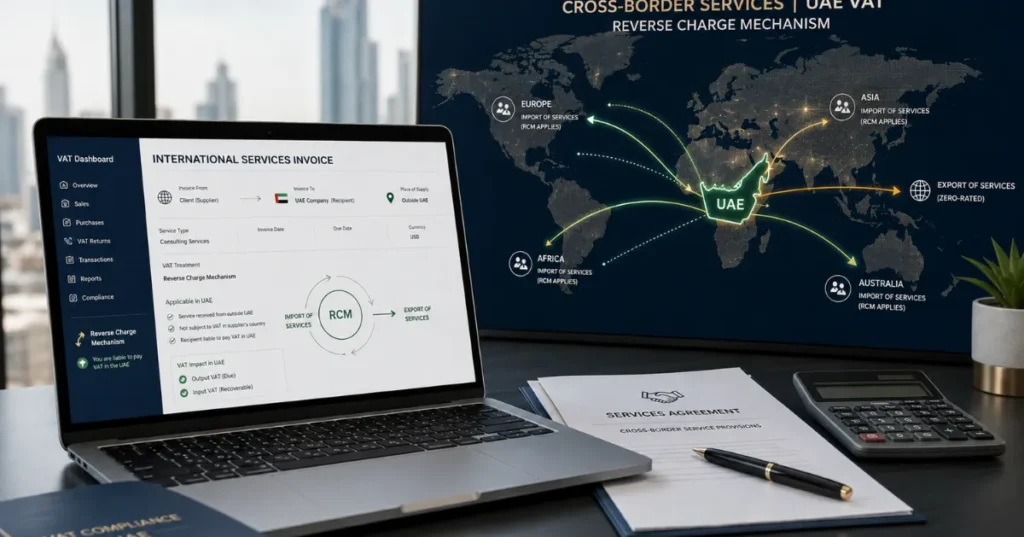
The following examples illustrate how businesses should approach place of supply assessments under the UAE VAT framework. Every transaction should be reviewed based on its specific facts and the applicable provisions of the UAE VAT legislation.
Scenario 1: UAE Company Providing Services to Another UAE Business
A Dubai-based accounting firm provides bookkeeping services to a company in Abu Dhabi.
- Supplier established in the UAE.
- Customer established in the UAE.
- General place of supply rule typically applies.
- VAT treatment should follow the applicable UAE VAT provisions.
Scenario 2: UAE Business Serving an Overseas Customer
A UAE marketing agency provides digital marketing services to a company located outside the UAE.
The business should assess:
- Customer’s place of establishment.
- Nature of the service.
- Whether a special place of supply rule applies.
- Whether the conditions for zero-rating, if applicable, are satisfied.
Scenario 3: Foreign Supplier Providing Services to a UAE Business
A UAE company purchases management consultancy services from an overseas consultancy firm. The UAE business should determine whether the Reverse Charge Mechanism (RCM) applies and ensure the transaction is reported correctly in its VAT return where required.
Scenario 4: Digital Service Provider
A UAE software company supplies cloud-based software subscriptions to customers in different countries.
The business should establish procedures to:
- Verify customer location.
- Apply the correct place of supply rule.
- Maintain supporting evidence.
- Issue VAT-compliant invoices.
Scenario 5: Event Management Company
A company organises a business conference in the UAE for international participants.
The VAT treatment depends on the applicable place of supply provisions relating to event and admission services. Businesses should evaluate each service supplied as part of the event separately where necessary.
How to Determine the Correct Place of Supply
Applying a consistent review process helps businesses reduce VAT errors and improve compliance.
Step 1: Identify the Type of Service
Determine exactly what service is being supplied.
Examples include:
- Consultancy
- Digital services
- Real estate services
- Transport services
- Training services
- Financial services
- Event services
The nature of the service determines whether the general or a special rule applies.
Step 2: Identify the Customer’s Location
Confirm where the customer is established or normally resides.
Supporting evidence may include:
- Trade licence
- Tax Registration Number (TRN), where applicable
- Commercial registration
- Contractual information
- Official business address
Step 3: Identify the Supplier’s Establishment
Determine whether the supplier is established in the UAE or another jurisdiction.
This is an important factor when applying the general place of supply rule.
Step 4: Check Whether a Special Rule Applies
Review whether the service falls within a category that has specific place of supply provisions, such as:
- Real estate
- Events
- Telecommunications
- Electronic services
- Transport
- Accommodation
Special rules take precedence over the general rule where applicable.
Step 5: Determine the Correct VAT Treatment
After identifying the place of supply, determine the appropriate VAT treatment in accordance with the UAE VAT legislation.
Step 6: Retain Supporting Evidence
Maintain documentation supporting the VAT position adopted. Good record-keeping is essential for demonstrating compliance during an FTA review or audit.
Documents Required to Support Place of Supply
Businesses should maintain complete and accurate records for every service transaction.
Recommended documentation includes:
- Tax invoice
- Service agreement or contract
- Purchase order
- Customer commercial registration
- Customer TRN (where applicable)
- Proof of customer location
- Payment records
- Bank transfer confirmation
- Email correspondence
- Project documentation
- Work completion reports
- Travel records, where relevant
- Delivery or service completion evidence
- Internal VAT assessment notes
Maintaining complete documentation helps substantiate the VAT treatment applied and supports compliance with UAE record-keeping requirements.
Common Place of Supply Mistakes Businesses Make
Many VAT errors arise because businesses apply the general rule without checking whether a special provision applies.
Common mistakes include:
- Assuming every overseas service is zero-rated.
- Ignoring special place of supply rules.
- Applying VAT without verifying the customer’s location.
- Incorrectly applying the Reverse Charge Mechanism.
- Issuing invoices with incorrect VAT treatment.
- Misclassifying digital services.
- Failing to retain supporting documentation.
- Reporting transactions incorrectly in VAT returns.
- Not reviewing contracts before invoicing.
- Relying on assumptions instead of documented evidence.
Regular VAT reviews help identify and correct these issues before they become compliance risks.
UAE VAT Compliance Tips for Service Businesses
Businesses can strengthen VAT compliance by following practical internal controls.
Best practices include:
- Review every service before issuing an invoice.
- Verify customer information and business status.
- Maintain complete contractual documentation.
- Retain evidence supporting customer location.
- Monitor updates to UAE VAT legislation and FTA guidance.
- Conduct periodic internal VAT reviews.
- Train finance and accounting teams.
- Ensure ERP and accounting systems apply the correct VAT treatment.
- Reconcile VAT records before submitting VAT returns.
- Seek professional advice for complex or cross-border transactions.
Strong compliance procedures reduce the risk of VAT errors and administrative penalties.
How Ripple Business Setup Helps Businesses Manage UAE VAT Compliance
Managing place of supply rules can become complex, particularly for businesses involved in cross-border trade, digital services, consultancy, and international operations. Correctly applying UAE VAT legislation requires careful analysis of each transaction and accurate documentation.
Ripple Business Setup supports businesses by providing professional VAT services, including:
- VAT registration and deregistration assistance
- VAT advisory for domestic and international transactions
- VAT return preparation and filing
- Place of supply assessments
- Reverse Charge Mechanism guidance
- VAT health checks and compliance reviews
- VAT documentation support
- Assistance during FTA audits and tax reviews
- Ongoing VAT compliance advisory
Professional VAT guidance helps businesses reduce compliance risks, improve reporting accuracy, and apply the correct VAT treatment with confidence.
Contact Ripple Business Setup
Phone: +971 50 593 8101
WhatsApp: +971 4 250 0833
Email: info@ripplellc.ae
FAQ
What is the place of supply for services under UAE VAT?
The place of supply determines the jurisdiction in which a service is considered supplied for VAT purposes. It helps determine whether UAE VAT applies and which VAT rules govern the transaction.
Does every service follow the same place of supply rule?
No. While many services follow the general rule, certain services—such as real estate, transport, telecommunications, electronic services, accommodation, and event-related services—are subject to special place of supply provisions.
Are services supplied to overseas customers always zero-rated?
No. Supplying services to a customer outside the UAE does not automatically qualify for zero-rating. Businesses must assess the transaction against the applicable conditions set out in the UAE VAT legislation.
What is the Reverse Charge Mechanism?
The Reverse Charge Mechanism (RCM) shifts the responsibility for accounting for VAT on certain imported services from the overseas supplier to the UAE recipient, where the relevant legal conditions are met.
Why is customer location important?
Customer location is a key factor in determining the correct place of supply for many service transactions and helps establish the appropriate VAT treatment.
What records should businesses retain?
Businesses should keep tax invoices, contracts, customer information, payment records, correspondence, project documentation, and any evidence supporting the VAT treatment applied.
Can incorrect place of supply decisions result in penalties?
Yes. Applying the wrong VAT treatment or failing to comply with UAE VAT requirements may result in additional tax assessments, administrative penalties, and increased scrutiny during an FTA audit.
How often should businesses review their VAT processes?
Businesses should review their VAT procedures regularly, particularly when introducing new services, entering international markets, implementing digital business models, or when there are updates to UAE VAT legislation or FTA guidance.
Disclaimer: This article is for general informational purposes only and does not constitute legal, tax, or financial advice. UAE VAT laws and FTA guidance may change over time. Businesses should consult a qualified UAE VAT advisor for advice specific to their circumstances.