
Dubai’s construction and interior sectors have never been busier. With billions of dirhams flowing into hospitality, retail, and residential projects, demand for skilled fit-out professionals is at an all-time high. If you want a piece of that market, you need one essential document: a Dubai Fit-out License.
What makes 2026 especially exciting is that recent legal reforms now allow foreign investors to hold 100% ownership on a mainland fit-out company, with no local sponsor required. In this guide, you will learn exactly what the license covers, how to get it, and the three smart moves that put full ownership in your hands.
What is a Dubai Fit-out License?
A Dubai Fit-out License is a commercial trade license issued to businesses that carry out interior finishing and improvement works inside a building. In practical terms, this covers partitioning and wall systems, suspended ceilings, floor finishes, joinery, light MEP (mechanical, electrical, and plumbing) modifications, and general space-customisation works.
It is important to understand how this differs from a general contracting license. A general contracting license permits structural work, foundations, beams, and load-bearing elements. A fit-out license focuses strictly on the interior environment once the shell of a building is complete. If your business fits offices, retail units, restaurants, or hotel rooms, a fit-out license is the correct and legally required permit.
Who exactly needs this license? Any company that performs interior works commercially in Dubai, whether for corporate clients, developers, or individual property owners, must hold a valid fit-out license before commencing work. Operating without one can result in project shutdowns, fines, and reputational damage.
Types of Fit-out Licenses in Dubai
Before applying, you need to choose the right jurisdiction. Dubai offers two main paths: the mainland and the free zone, each with distinct rules on ownership, market access, and approvals.
- Mainland Fit-out License (DED): Issued by the Department of Economy and Tourism (DET, formerly DED). As of recent reforms, 100% foreign ownership is permitted for most commercial activities, including fit-out. You can trade directly with any client across the UAE without restrictions.
- Free Zone Fit-out License: Issued by the relevant free zone authority (e.g., IFZA, Meydan, RAKEZ). Always offered with 100% foreign ownership. Best for companies whose clients are largely within the same free zone or who operate internationally. To work on mainland projects, a free zone company typically needs a mainland service agent or a branch.
- Offshore Company: Not suitable for operational fit-out work inside the UAE. Offshore entities cannot obtain commercial premises or execute local projects directly.
| Criteria | Mainland (DET) | Free Zone |
|---|---|---|
| Ownership | 100% foreign (post-reform) | 100% foreign |
| UAE market access | Unrestricted | Limited (agent needed for mainland) |
| Approval authority | DET + Dubai Municipality | Free zone authority |
| Typical cost range | AED 20,000 – 35,000+ | AED 15,000 – 28,000+ |
3 Secrets to Get 100% Ownership on a Dubai Fit-out License
The concept of 100% foreign ownership in mainland Dubai was once impossible for most business categories. Three strategic decisions now make it a straightforward reality for fit-out entrepreneurs.
1. Choose the Right Jurisdiction
Following the UAE’s landmark Commercial Companies Law amendments, the requirement for a local Emirati sponsor has been removed for the vast majority of mainland business activities and fit-out is firmly on that list. This means you can now own 100% of a mainland DET-licensed fit-out company without sharing equity or paying a sponsorship fee.
The choice between mainland and free zone now hinges on your business model, not ownership. If your pipeline includes government tenders, large developer projects, and retail clients across Dubai, a mainland license gives you the broadest reach. A small interior design studio focusing on a specific free zone community, however, might find a free zone license more cost-effective with equally full ownership.
2. Select the Correct Business Activity
Business activity selection is one of the most consequential and most underestimated decisions in UAE company formation. The activities listed on your trade license define exactly what you are legally permitted to do. Choosing “interior design consultancy” when you intend to carry out physical fit-out works, for instance, will invalidate your contracts and create issues with Dubai Municipality site permits.
For a fit-out operation, the correct activities typically include interior decoration works, general maintenance, and light MEP works, depending on your scope. Selecting the right combination also affects which external approvals you will need and determines your future expansion options. Adding or changing activities after formation is possible but takes time and incurs fees. Getting it right at the start saves significant effort later.
3. Structure Your Company Smartly
Even with full ownership permitted, your legal structure still matters. Most mainland fit-out companies register as a Limited Liability Company (LLC) with a single shareholder, a clean, simple structure that reflects full foreign ownership without ambiguity. A sole establishment (sole proprietorship) is another option for individual investors, though it carries unlimited liability.
Step-by-Step Process to Get a Dubai Fit-out License
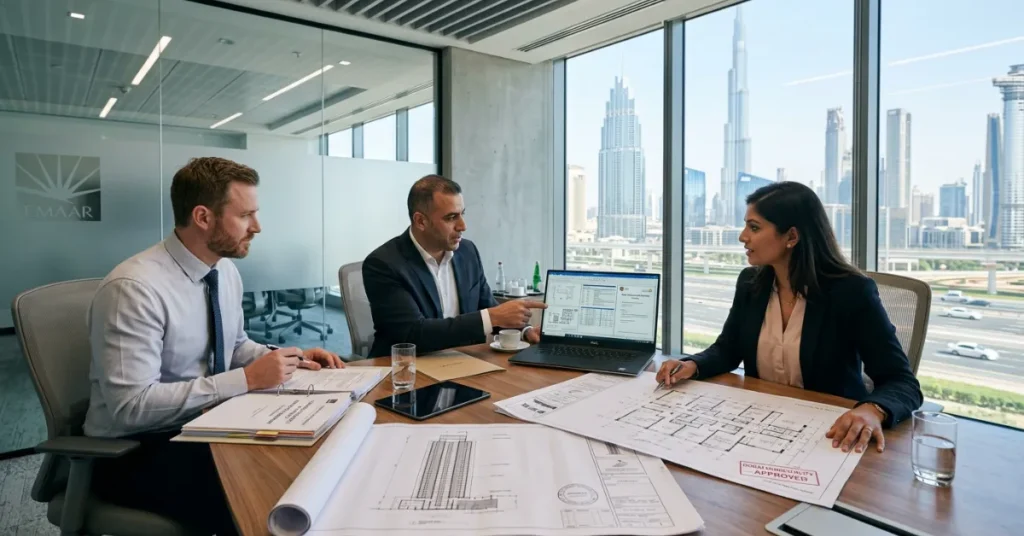
The process typically takes 2–4 weeks when documents are in order, and the right approvals are sought without delay.
- Choose your business activities precisely (fit-out, maintenance, MEP, etc.)
- Reserve and approve your company’s trade name with DET or the relevant free zone
- Submit an initial approval application along with passport copies and business plan details
- Draft and notarise the Memorandum of Association (MOA) required for a mainland LLC
- Secure a physical office or registered address (mandatory for mainland licensing)
- Obtain external approvals from Dubai Municipality and Civil Defence as applicable
- Pay license fees and collect your final trade license from DET or free zone authority
Cost of a Dubai Fit-out License in 2026
The cost of a Dubai Fit-out License in 2026 depends on several factors, including the business location, company structure, and the scope of activities you choose. On average, entrepreneurs can expect to invest between AED 15,000 and AED 35,000 for a basic setup. This usually covers the trade license fee, initial approvals, and registration costs. However, the total cost can increase if you include office space, which is mandatory for mainland companies, as well as external approvals from authorities like Dubai Municipality and Civil Defense. Free zone options may offer lower starting costs and flexible office solutions, making them attractive for startups. It’s important to plan your budget carefully, as additional expenses such as visa allocations, documentation, and fit-out approvals can impact the final investment required to launch your business successfully.
Key Approvals Required for Fit-out Companies
A fit-out license does not operate in isolation. Depending on your business activities and the nature of projects you undertake, you will need approvals from:
- Dubai Municipality: approves fit-out drawings and site permits for most commercial and residential projects
- Dubai Civil Defence: mandatory for any works involving fire suppression, alarms, or emergency systems
- Trakhees: required for projects within JAFZA and certain Dubai South zones instead of Dubai Municipality
- DEWA (Dubai Electricity & Water Authority): involved when MEP works include electrical connections or significant water installations
Benefits of Starting a Fit-out Business in Dubai

Dubai’s real estate sector continues to expand at a pace that few markets can match. With major hotel brands, retail expansions, and luxury residential developments constantly underway, the demand for interior fit-out services remains consistently high. The UAE’s Expo legacy infrastructure, combined with the government’s tourism and investment strategy for 2031, ensures a long pipeline of projects.
Beyond the construction boom, Dubai offers genuine fiscal advantages. There is no personal income tax and no corporate tax for businesses below the AED 375,000 profit threshold, making it financially attractive to operate here. The city’s geographic position also makes it a natural hub for GCC project work a Dubai-based fit-out company can serve Saudi Arabia, Qatar, and Oman efficiently from one base.
Common Mistakes to Avoid
- Choosing the wrong activity code: This leads to permit rejections on-site and legal complications with clients
- Skipping external approvals: Dubai Municipality and Civil Defence approvals are not optional; projects get shut down without them
- Underestimating total setup costs: Factor in office rent, visa quotas, and approval fees beyond the base license cost
- Not planning for scalability: If you intend to hire technicians and subcontractors, ensure your license supports the right visa allocation from the start
- Accepting an old-model sponsorship arrangement: The law has changed; 100% ownership is your legal right in most activity categories
Mainland vs Free Zone Fit-out License
The comparison below summarises the key differences to help you decide where to register. For most active fit-out businesses that want to work across Dubai, the mainland remains the stronger long-term choice:
| Factor | Mainland (DET) | Free Zone |
|---|---|---|
| Ownership | 100% foreign | 100% foreign |
| Initial cost | Moderate–High | Low–Moderate |
| Flexibility | High | Medium |
| UAE market reach | Unrestricted | Zone + International |
| Government tenders | Yes | Limited |
Example: How a Fit-out Company Started in Dubai
- Background: A British interior contractor with 12 years of experience in commercial fit-out wanted to expand into the UAE market in mid-2024. He chose a mainland LLC structure under DET, selecting activities covering interior decoration works and general maintenance.
- Timeline: Initial approval received in 3 days. MOA notarised within a week. Dubai Municipality approval for the activity profile took 10 working days. Total time from application to final license: 19 days.
- Cost: Total setup investment of AED 31,200, including a flexi-office package for the first year. He retained 100% ownership with no local sponsor involved.
- Outcome: Within four months of licensing, the company secured two retail fit-out contracts totalling AED 1.4 million. Having a mainland license was decisive in winning both tenders, as clients required the contractor to hold a Dubai Municipality-registered trade license.
How Ripple Business Setup Helps You Get a Dubai Fit-out License
Setting up a Dubai Fit-out License can feel complex, especially with multiple approvals, legal steps, and ownership structures involved. Ripple Business Setup makes the process simple by guiding you through every stage, from selecting the right business activity to securing approvals from relevant authorities. Their team helps you choose the best jurisdiction for 100% ownership, prepares all documentation, and ensures fast and compliant license issuance so you can focus on growing your business. To get started, contact Ripple Business Setup at +971 50 593 8101, email info@ripplellc.ae, or WhatsApp +971 4 250 0833.
Conclusion
Getting a Dubai Fit-out License in 2026 is a well-defined process and with the right knowledge, you can structure it for complete foreign ownership from day one. The three core decisions are jurisdiction, activity selection, and company structure. Get those right, secure the necessary approvals, and you have a fully compliant, 100%-owned business operating in one of the world’s most active construction markets.
Whether you are a solo interior design professional or scaling a multi-team contracting operation, Dubai gives you the legal framework and market demand to build something substantial. The key is starting with the correct foundation.
Disclaimer: The information provided in this article is for general guidance only and may change based on UAE laws and regulations. It is recommended to consult with professional business setup advisors before making any decisions.