Managing business expenses has become increasingly complex in today’s fast-moving business environment. Companies handle numerous transactions daily, including vendor payments, employee reimbursements, travel expenses, subscriptions, and operational costs. While these expenses are necessary for growth, managing them manually often creates inefficiencies, errors, and unnecessary administrative burdens.
What Is Automated Expense Management?
Automated expense management refers to the use of technology and software to capture, process, approve, track, and report business expenses with minimal manual intervention.
Instead of relying on spreadsheets, paper receipts, and manual data entry, businesses use expense management software that automatically records transactions, categorizes expenses, and integrates with accounting systems.
Modern expense management solutions often leverage cloud technology, artificial intelligence (AI), and machine learning to simplify accounting workflows and reduce administrative workload.
How Automated Expense Management Works
Most automated expense management systems follow a straightforward process:
- Employees submit expenses through a mobile app or web portal.
- The system captures receipt data using OCR (Optical Character Recognition).
- Expenses are automatically categorized.
- Approval workflows route submissions to the appropriate managers.
- Approved expenses sync directly with accounting software.
- Real-time reports update financial dashboards automatically.
This streamlined process significantly improves efficiency and reduces the risk of human error.
Why Traditional Expense Management Creates Problems for Businesses
Many organizations still rely on manual expense tracking methods. While these approaches may work for small transaction volumes, they become increasingly inefficient as businesses grow.
Manual accounting processes often create delays, inaccuracies, and compliance challenges that affect overall business performance.
Manual Data Entry Errors
Human error remains one of the biggest challenges in accounting. Employees may enter incorrect amounts, categorize expenses improperly, or accidentally duplicate entries.
Even small mistakes can create discrepancies in financial statements and affect budgeting decisions.
Lost Receipts and Missing Documentation
Paper receipts are easy to lose, damage, or misplace. Missing documentation can create significant challenges during audits and tax reporting.
Automated systems store receipts digitally, ensuring important records remain accessible whenever needed.
Delayed Expense Reimbursements
Manual approval processes often slow down reimbursements. Employees may wait weeks for approvals and payments, reducing satisfaction and creating administrative frustration.
Automation accelerates approvals and reimbursement cycles.
Lack of Real-Time Visibility
Traditional methods rarely provide immediate insight into spending patterns. Decision-makers often rely on outdated reports, making it difficult to monitor expenses effectively.
Automated expense tracking provides instant visibility into company spending.
Compliance and Audit Challenges
Businesses must maintain accurate records to satisfy tax regulations and audit requirements. Manual systems increase the likelihood of incomplete records and compliance violations.
Common issues associated with traditional expense management include:
- Duplicate expense claims
- Data entry mistakes
- Delayed financial reporting
- Higher processing costs
- Reduced productivity
- Poor spending oversight
- Increased audit risks
Key Benefits of Automation in Expense Management
Automation offers significant advantages that extend beyond simply reducing paperwork.
Improved Accuracy in Accounting Records
One of the most valuable benefits of automation is enhanced accuracy. Automated systems eliminate repetitive manual tasks that often lead to mistakes. Software consistently categorizes expenses according to predefined rules, ensuring uniform accounting records.
As a result, businesses gain more reliable financial data and improved reporting accuracy.
Benefits include:
- Fewer data entry errors
- Consistent expense classification
- Improved bookkeeping accuracy
- More reliable financial statements
Significant Time Savings
Manual expense processing consumes substantial administrative time. Employees spend hours collecting receipts, entering information, following up on approvals, and reconciling expenses.
Automation dramatically reduces these repetitive tasks by:
- Capturing expense data automatically
- Routing approvals instantly
- Generating reports automatically
- Syncing transactions with accounting platforms
Finance teams can then focus on strategic activities rather than administrative work.
Real-Time Expense Visibility
Business leaders need immediate access to financial information.
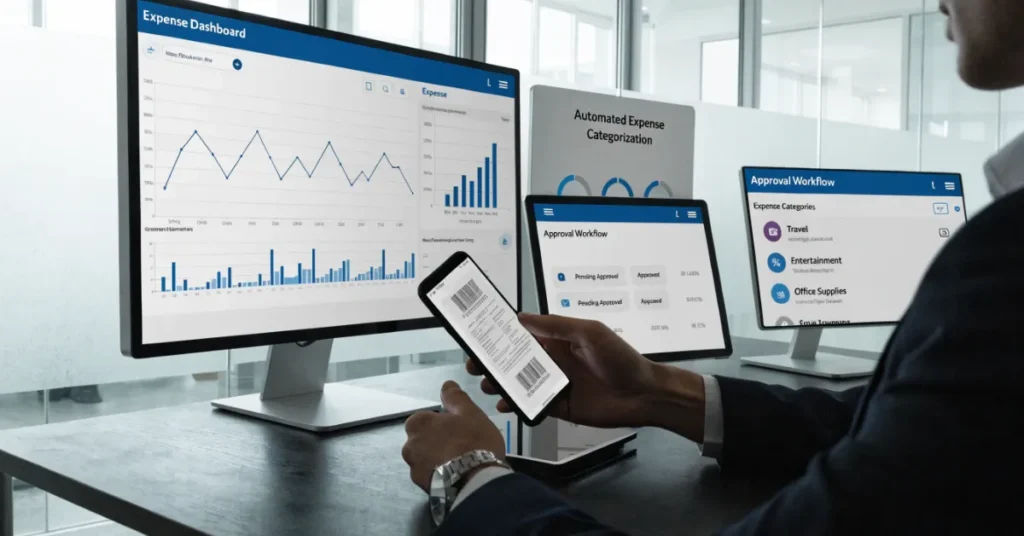
Automated expense management systems provide real-time dashboards that display:
- Current spending trends
- Departmental expenses
- Budget utilization
- Cash flow impacts
- Policy compliance metrics
This visibility helps managers make informed financial decisions and identify potential issues before they escalate.
Better Compliance and Audit Readiness
Compliance requirements continue to grow across industries.
Automated systems help organizations maintain complete records through:
- Digital receipt storage
- Automated audit trails
- Policy enforcement controls
- Secure document retention
These features simplify audits and reduce compliance risks.
Cost Reduction Across the Organization
Expense management automation can significantly lower operational costs.
Businesses reduce expenses associated with:
- Manual processing
- Paper storage
- Administrative labor
- Compliance violations
- Fraudulent claims
Improved spending visibility also helps organizations identify unnecessary expenditures and optimize budgets.
Essential Features to Look for in Expense Management Automation Software
Not all expense management platforms offer the same capabilities. Businesses should evaluate software based on features that support their accounting objectives.
Receipt Scanning with OCR Technology
OCR technology automatically extracts data from receipts, invoices, and bills.
Employees simply take a photo of a receipt, and the software captures:
- Vendor information
- Transaction date
- Expense amount
- Tax details
This feature eliminates manual data entry and improves accuracy.
Automated Expense Categorization
Advanced systems automatically assign expenses to appropriate accounting categories based on predefined rules. This capability improves bookkeeping consistency and accelerates reporting.
Approval Workflow Automation
Businesses can create customized approval chains that automatically route expense claims to managers. Automated workflows reduce bottlenecks and speed up decision-making.
Accounting Software Integration
The best expense management solutions integrate seamlessly with accounting platforms such as:
- QuickBooks
- Xero
- Zoho Books
- Sage Accounting
Integration eliminates duplicate work and keeps financial records synchronized.
Mobile Expense Reporting
Mobile applications allow employees to submit expenses anytime and from anywhere.
This flexibility improves compliance and reduces delays.
AI-Powered Fraud Detection
Artificial intelligence can identify unusual spending patterns and flag potentially fraudulent transactions for review. This added layer of protection helps organizations reduce financial risk.
Custom Expense Policies
Businesses can configure software to enforce internal spending policies automatically. Policy-based controls improve compliance and reduce unauthorized spending.
Real-Time Analytics Dashboard
Interactive dashboards provide valuable insights into business spending behavior. Finance leaders can monitor trends, evaluate performance, and make informed decisions using real-time data.
How Automation Improves Financial Decision-Making
Accurate financial decisions depend on timely and reliable information. Automated expense management provides real-time data that helps business leaders understand spending patterns and make proactive decisions.
Instead of waiting for month-end reports, finance teams can access up-to-date expense information whenever they need it.
Smarter Budget Planning
Automation provides detailed insights into historical spending trends, allowing businesses to create more realistic budgets.
By analyzing expense data automatically, organizations can:
- Identify recurring costs
- Forecast future expenditures
- Allocate resources efficiently
- Avoid budget overruns
Better budgeting improves financial stability and supports long-term growth.
Improved Cash Flow Management
Cash flow remains one of the most critical indicators of business health.
Automated expense tracking enables businesses to monitor outgoing payments in real time and anticipate future obligations.
This visibility helps organizations:
- Maintain healthy cash reserves
- Avoid unexpected shortfalls
- Improve payment planning
- Support strategic investments
Strategic Cost Optimization
Expense management automation highlights spending trends that may otherwise go unnoticed.
Businesses can identify:
- Unnecessary subscriptions
- Duplicate expenses
- Vendor pricing inconsistencies
- Departmental overspending
These insights help organizations reduce waste and improve profitability.
Common Expense Management Processes That Can Be Automated
Many routine financial tasks can be automated to improve efficiency and accuracy.
Expense Processes Suitable for Automation
- Employee expense submissions
- Receipt collection and storage
- Expense categorization
- Approval workflows
- Travel and entertainment expense tracking
- Mileage reimbursement calculations
- Vendor invoice processing
- Employee reimbursements
- Financial reporting
- Budget monitoring
- Compliance verification
- Audit preparation
Automating these processes allows finance teams to focus on strategic planning rather than repetitive administrative work.
The Role of AI and Machine Learning in Modern Expense Management
Artificial intelligence is reshaping the future of accounting and expense management.
Modern software solutions use machine learning algorithms to analyze financial data, identify patterns, and improve automation accuracy over time.
Smart Receipt Recognition
AI-powered OCR technology extracts receipt data with exceptional accuracy.
The system can recognize:
- Vendor names
- Transaction dates
- Tax amounts
- Payment methods
- Expense categories
This reduces manual effort and improves record accuracy.
Predictive Expense Analysis
Machine learning can analyze historical spending data and predict future expense trends.
Businesses gain valuable insights into:
- Seasonal spending fluctuations
- Budget risks
- Cost-saving opportunities
- Future financial requirements
Automatic Policy Compliance Checks
AI systems automatically compare submitted expenses against company policies.
If an expense violates internal guidelines, the system can:
- Flag the transaction
- Request additional documentation
- Route it for further review
This improves compliance and reduces risk.
Fraud Detection and Risk Monitoring
Artificial intelligence can identify unusual spending behaviors that may indicate fraud.
Examples include:
- Duplicate submissions
- Excessive reimbursements
- Unauthorized purchases
- Abnormal spending patterns
Early detection protects businesses from financial losses.
Intelligent Spending Insights
AI-driven analytics transform raw expense data into actionable business intelligence.
Finance leaders can identify trends, improve forecasting, and make more informed decisions based on accurate financial information.
Real-World Example: How a Growing Business Reduced Accounting Workload Through Automation

Challenge
A growing services company managed employee expenses using spreadsheets and paper receipts.
The finance team faced several challenges:
- Delayed approvals
- Lost documentation
- Time-consuming reconciliations
- Limited spending visibility
Monthly expense processing required several days of manual work.
Solution
The company implemented an automated expense management platform integrated with its accounting software.
The new system introduced:
- Mobile expense submission
- OCR receipt scanning
- Automated categorization
- Approval workflows
- Real-time reporting
Results
Within six months, the business achieved:
- 70% reduction in expense processing time
- Faster reimbursement cycles
- Improved compliance
- Better spending visibility
- Reduced administrative costs
The finance team redirected its efforts toward financial analysis and strategic planning rather than data entry.
Steps to Successfully Implement Expense Management Automation
A successful implementation requires careful planning and execution.
Step 1: Analyze Current Expense Processes
Start by reviewing existing workflows.
Identify:
- Manual tasks
- Bottlenecks
- Error-prone activities
- Reporting challenges
Understanding current inefficiencies helps define automation goals.
Step 2: Identify Operational Bottlenecks
Determine where delays occur most frequently.
Common bottlenecks include:
- Receipt collection
- Approval chains
- Reimbursement processing
- Data entry
These areas often provide the highest return on automation investment.
Step 3: Choose the Right Automation Platform
Evaluate software based on:
- Ease of use
- Integration capabilities
- Security features
- Scalability
- Reporting functionality
Select a solution that aligns with your business requirements and growth plans.
Step 4: Integrate Accounting Systems
Integration ensures expense data flows directly into accounting records.
This eliminates duplicate work and improves data consistency across financial systems.
Step 5: Train Employees
Employee adoption plays a critical role in implementation success.
Provide training on:
- Expense submission procedures
- Mobile applications
- Approval workflows
- Policy compliance requirements
Proper training increases user acceptance and reduces resistance to change.
Step 6: Monitor and Optimize
Automation is not a one-time project.
Regularly review:
- System performance
- User feedback
- Reporting accuracy
- Compliance outcomes
Continuous optimization ensures maximum value from the investment.
Common Mistakes Businesses Make When Automating Expense Management
While automation delivers significant benefits, poor implementation can limit results.
Choosing Software Based Only on Price
Low-cost solutions may lack essential features, integrations, or scalability.
Businesses should evaluate long-term value rather than upfront cost alone.
Ignoring Employee Adoption
Even the best software fails if employees do not use it properly.
Organizations should prioritize training and user experience.
Poor Integration Planning
Disconnected systems create data silos and duplicate work.
Proper integration planning ensures smooth information flow across accounting platforms.
Not Defining Expense Policies
Automation works best when clear spending policies exist.
Businesses should establish guidelines before implementing automated controls.
Failing to Review Automation Reports
Automated systems generate valuable insights, but businesses must actively review reports and act on findings.
Ignoring analytics limits the strategic benefits of automation.
Future Trends in Expense Management Automation
Technology continues to reshape accounting and financial management.
Several emerging trends will influence the future of expense management.
AI-Driven Accounting
Artificial intelligence will handle increasingly complex accounting tasks, improving efficiency and accuracy.
Touchless Expense Processing
Future systems will process expenses automatically from submission to approval without human intervention.
Predictive Financial Analytics
Advanced analytics will help businesses forecast spending patterns and identify risks before they occur.
Voice-Enabled Expense Capture
Voice technology may allow employees to record expenses using simple voice commands.
Mobile-First Accounting
Businesses will continue adopting mobile solutions that support remote work and real-time expense reporting.
Blockchain-Based Verification
Blockchain technology may enhance transparency, security, and auditability in financial transactions.
Real-Time Compliance Monitoring
Future systems will automatically monitor changing regulations and ensure ongoing compliance.
Why Businesses Should Embrace Expense Management Automation Today
Expense management automation is no longer a luxury reserved for large enterprises. It has become a practical solution for businesses of all sizes seeking greater efficiency and financial control.
By automating routine accounting processes, organizations can:
- Improve accuracy
- Reduce administrative workload
- Strengthen compliance
- Enhance visibility into spending
- Lower operational costs
- Improve cash flow management
- Support strategic decision-making
Businesses that embrace automation today position themselves for greater agility, scalability, and long-term success.
How Ripple Business Setup Can Support Your Business Automation Journey
Implementing automation for expense management becomes more effective when your business is built on a strong financial and operational foundation. Ripple Business Setup helps entrepreneurs, startups, SMEs, and growing companies establish compliant business structures while supporting efficient accounting and financial management practices. From company formation and bookkeeping guidance to VAT compliance and accounting support, Ripple Business Setup assists businesses in creating streamlined processes that improve operational efficiency. If you’re planning to automate your expense management and accounting workflows, professional guidance can help ensure your systems, compliance requirements, and financial processes are aligned for long-term growth. To learn more about business setup, accounting support, and financial management solutions, contact Ripple Business Setup at +971 50 593 8101, email info@ripplellc.ae, or WhatsApp +971 4 250 0833.
FAQ
What is expense management automation?
Expense management automation uses software and technology to capture, process, track, approve, and report business expenses with minimal manual effort.
How does automation improve accounting accuracy?
Automation eliminates manual data entry errors, standardizes expense categorization, and ensures consistent financial recordkeeping.
Can small businesses benefit from expense automation?
Yes, Small businesses often gain significant benefits through reduced administrative workload, faster reporting, and improved financial visibility.
Is expense management software secure?
Most modern platforms use encryption, access controls, cloud security measures, and audit trails to protect sensitive financial data.
How much time can automation save finance teams?
Many businesses report reducing expense processing time by 50% to 80%, depending on the complexity of their workflows.
What accounting software integrates with expense management tools?
Many expense management solutions integrate with QuickBooks, Xero, Zoho Books, Sage Accounting, and other popular accounting platforms.
Does automation help during audits?
Yes, Automated systems maintain digital records, audit trails, and organized documentation that simplify audit preparation and compliance reviews.
Conclusion
Manual expense management methods often create inefficiencies, increase errors, and limit financial visibility. As businesses grow, these challenges become more difficult to manage effectively. Automation provides a smarter approach to expense management and accounting by streamlining workflows, improving accuracy, strengthening compliance, and delivering real-time financial insights. From receipt scanning and automated approvals to AI-powered analytics and fraud detection, modern expense management solutions help organizations operate more efficiently and make better financial decisions.
Disclaimer: The information provided in this article is for general educational and informational purposes only. While every effort has been made to ensure accuracy, accounting regulations, tax requirements, and business practices may change over time. Readers should consult qualified accounting, tax, or business professionals before making financial or operational decisions based on the information presented in this article.