Choosing a UAE Business Setup should involve more than comparing licence costs or picking a popular free zone. Where your customers are located can also influence how you structure and operate your company. A business serving UAE customers may have different practical requirements from one serving clients across Europe, Asia, Africa, or North America. However, customer location is only one part of the decision. Your business activity, legal form, shareholder structure, physical presence, licensing requirements, and operating model also matter. The UAE’s official company formation process starts by identifying the economic activity and then selecting an appropriate legal form, trade name, location, and required approvals.
Understanding these factors before you start company UAE activities can help you avoid choosing a setup that does not match the way your business actually operates.
Why Customer Location Matters in a UAE Business Setup
Your target customers can affect how you plan your company’s operations, licensing, premises, payments, and market access. For example, a consulting company serving UAE corporations may need to consider its local operating model differently from a software company providing subscriptions to customers in several countries.
Before beginning the UAE setup process, ask:
- Where are most of your customers located?
- Will you sell products or services?
- Will customers purchase directly through your website?
- Do you need a physical office, shop, warehouse, or other premises?
- Will you import products into the UAE?
- Will you employ staff or require visas?
- Will customers mainly pay from UAE or overseas accounts?
- Does your planned business activity require additional approvals?
Customer location should therefore be treated as part of a wider business planning exercise rather than as the only factor determining your setup.
Mainland or Free Zone? Start With Your Customer Base
Mainland and free zone structures can serve different operating models, but neither option automatically suits every business simply because its customers are in a particular location. The appropriate choice depends on the licensed activity, operating requirements, premises, ownership structure, and applicable authority requirements.

When a Mainland Setup May Fit UAE-Focused Customers
A mainland structure may be considered by businesses that plan to operate directly within the UAE market, particularly where their activities involve local premises, physical operations, retail, professional services, or other requirements that make a mainland presence practical.
For example, a company providing services to UAE businesses may want to assess:
- Where it will conduct its operations
- Whether it needs a physical office
- Whether the activity has additional approvals
- How it will contract with customers
- Whether employees or visas are required
- Which local authority will issue the relevant licence
This does not mean every business with UAE customers must establish on the mainland. The business activity and operating model remain important.
When a Free Zone Setup May Fit an International Customer Base
Free zones can be relevant for businesses with internationally focused or digital operating models, including certain consulting, technology, e-commerce, professional, and service businesses.
An entrepreneur serving customers outside the UAE may consider factors such as:
- The permitted business activity
- Available legal forms
- Office or workspace options
- Visa requirements
- Banking preparation
- Import and export requirements
- The free zone’s specific rules
The key is to select a structure that supports the actual business model rather than assuming that international customers automatically require a free zone company.
Match Your Business Activity With Your Customer Location
Customer location matters, but your business activity often determines what type of licence and approvals you need. The UAE’s Ministry of Economy and Tourism states that company formation begins with identifying the economic activity. The activity influences the type of licence issued, while the legal form must correspond with the business requirements.
Service-Based Businesses
Consultants, marketing agencies, software providers, IT companies, and other professional service providers should first identify exactly what they intend to sell. For example, a company providing management consulting to UAE businesses should not select its activity simply because “consulting” sounds broad. The exact licensed activity should reflect the services the company plans to provide.
For international clients, the founder should also consider:
- How services will be delivered
- Where contracts will be signed
- How payments will be received
- Whether employees are needed
- Whether the company requires physical premises
This creates a more practical foundation for company formation UAE than choosing a licence based only on price.
E-Commerce and Trading Businesses
An e-commerce company needs to consider both its customers and its supply chain.
A business selling products to UAE customers may need to think about:
- Product sourcing
- Import arrangements
- Warehousing
- Inventory management
- Delivery
- Online payment systems
- E-commerce licensing
- Consumer-facing operations
A company selling primarily to international customers may have a different logistics model. Its setup should reflect where products are sourced, stored, shipped, and sold.
Physical Businesses
Businesses such as restaurants, clinics, retail stores, training centres, and logistics companies generally need more than an online registration.
Their planning can involve:
- Suitable premises
- Location requirements
- Municipality or sector approvals
- Operational permissions
- Staffing
- Customer access
- Health, safety, or other regulatory requirements where applicable
For these businesses, customer location is important, but the physical operating model can be equally significant.
How Customer Location Can Affect Your UAE Legal Structure
Choosing a legal form is another important stage of the UAE Business Setup process. The UAE’s official company-formation guidance explains that the legal form should correspond with the economic activity and business requirements.
Your structure may depend on factors such as:
- Number of shareholders
- Individual or corporate ownership
- Business activity
- Liability considerations
- Management structure
- Licensing authority
- Operational requirements
Consider Your Shareholder Structure Before Registration
Before registration, identify who will own and manage the company.
Consider:
- Number of shareholders
- Percentage of ownership
- Individual versus corporate shareholder
- Required identification documents
- Management responsibilities
- Future investment plans
This becomes particularly important for startups expecting to add investors or partners later.
UAE Startup Setup: Choose Around How You Will Operate
A successful UAE startup setup should begin with the business model rather than the licence brochure.
A founder should understand the customer journey before selecting a jurisdiction.
Ask These Questions Before Starting a UAE Company
- Where are the majority of customers?
- Are customers businesses or individual consumers?
- Are sales local or international?
- Is the business service-based or product-based?
- Does the company need an office?
- Will the company import or export?
- Will employees require UAE visas?
- Which business activity should appear on the licence?
- What legal form suits the ownership structure?
- Will the company need additional government approvals?
The answers help create a clearer setup plan and reduce the risk of selecting a structure that does not support future operations.
What to Check Before Choosing an Entrepreneur Licence
The term entrepreneur licence can describe different licensing options depending on the authority and activity. Founders should therefore examine the actual licence conditions instead of relying only on the label.
Check the Licensed Activity
The activity should accurately describe what the company will do. For example, a founder planning to provide software development services should check the available technology or software-related activities rather than selecting an unrelated general activity.
The Ministry of Economy and Tourism notes that the UAE has a wide range of economic activities and that the nature of the activity determines the type of licence issued.
Check the Trade Name and Registration Requirements
Your trade name is part of the company formation process. The official guidance states that a trade name should be unique and comply with applicable requirements, including alignment with the company’s activities and legal form.
Before submitting registration documents, review:
- Trade-name availability
- Legal form
- Business activity
- Shareholder information
- Required approvals
- Company documents
- Premises requirements where applicable
UAE Setup Process: From Customer Research to Licence
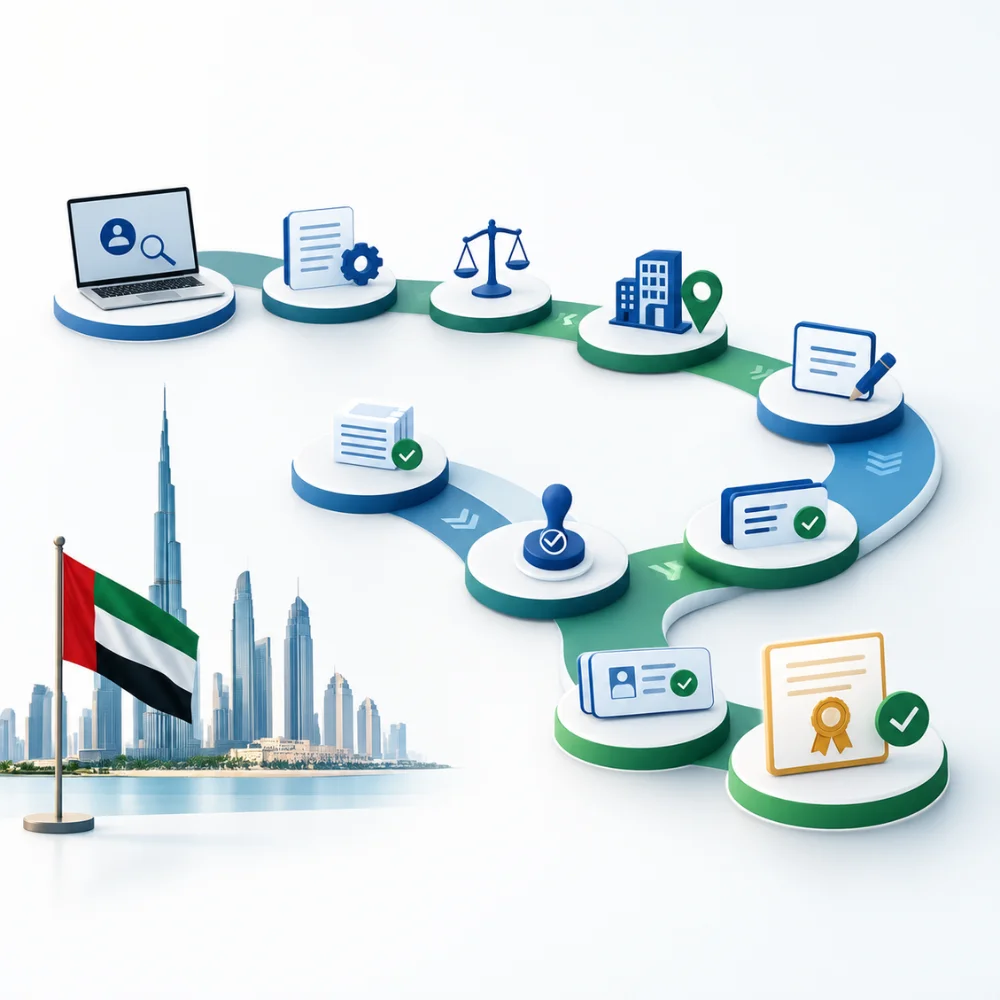
A practical UAE setup process can be approached in the following sequence:
- Identify your customer location – Separate UAE customers from international customers.
- Define your business activity – Determine exactly what the company will provide.
- Choose the legal form – Consider ownership and operational requirements.
- Assess mainland or free zone options – Compare the setup against your actual business model.
- Select the trade name – Check availability and naming requirements.
- Prepare shareholder documents – Gather passports, ownership details, and other required documents.
- Obtain initial or additional approvals – Some activities require approvals from relevant authorities.
- Complete registration – Submit the required documents and pay applicable fees.
- Obtain the business licence – The licence authorises the activities covered by the approved setup.
- Review post-licensing obligations – Consider banking, tax, accounting, visas, and ongoing compliance.
The UAE Ministry of Economy and Tourism describes company incorporation as a process that generally includes identifying the activity, determining the legal structure, registering the trade name, obtaining initial approval, selecting the business location, securing additional approvals where required, and submitting documents and fees.
Examples of UAE Business Setup Based on Customer Location
Example 1: UAE-Based Consulting Business
Imagine a consultant whose main customers are UAE companies.
The founder may need to evaluate the appropriate consulting activity, legal form, office requirements, shareholder structure, and licensing authority. The fact that customers are in the UAE is useful context, but it does not by itself determine the final structure.
Example 2: UAE Company Serving Global Clients
Consider a software services company with customers in the UK, Europe, and Asia.
The company may operate remotely, receive international payments, and deliver services digitally. Its founder should evaluate the appropriate software or technology activity, jurisdiction, office requirements, banking preparation, and compliance obligations.
Example 3: E-Commerce Business Selling to UAE Customers
Suppose an entrepreneur plans to sell consumer products online to customers across the UAE.
The founder should consider the e-commerce activity, inventory location, import arrangements, warehouse requirements, payment systems, delivery model, and applicable approvals.
The customer location provides an important starting point, but the complete supply chain determines the practical setup.
Common Mistakes When Choosing a UAE Business Setup
Founders can create avoidable problems when they focus on one factor and ignore the wider operating model.
Common mistakes include:
- Choosing a licence only because it appears inexpensive
- Selecting a jurisdiction before defining the business activity
- Assuming every international business needs the same free zone structure
- Ignoring the company’s physical operating requirements
- Selecting a legal form without considering shareholders
- Choosing an unsuitable trade name
- Forgetting additional approvals
- Ignoring banking and payment requirements
- Treating registration as the end of the setup process
- Failing to review tax and compliance obligations after incorporation
Tax obligations also need separate attention. For example, the Federal Tax Authority states that taxable persons subject to UAE Corporate Tax must register and obtain a Corporate Tax Registration Number according to the applicable rules.
Customer Location Is Important, But It Should Not Be the Only Factor
There is no single customer-location rule that determines the correct UAE setup for every company.
A stronger decision framework is:
Customer location + business activity + operating model + legal form + jurisdiction + licensing requirements
For example, two companies may both have customers in Dubai but require different structures because one operates an online consultancy while the other runs a physical retail business.
Likewise, two technology companies may both serve international customers but have different office, staffing, ownership, or licensing requirements.
This is why founders should evaluate the complete business model before choosing a business licence UAE option.
How to Choose the Right UAE Business Setup
Use this checklist before you start company UAE formation:
- Customer location: Where are your main customers?
- Business activity: What exactly will you sell?
- Target market: UAE, international, or both?
- Operating model: Online, physical, hybrid, or remote?
- Premises: Do you need an office, shop, warehouse, or other facility?
- Shareholders: Who owns the company?
- Legal form: Which structure fits the business?
- Trade name: Is your preferred name available and compliant?
- Licence: Does the proposed licence cover your actual activities?
- Approvals: Does the activity require additional permissions?
- Visas: Will the company need employee or investor visas?
- Banking: Can you prepare the required company and source-of-funds documents?
- Tax: What Corporate Tax or VAT obligations may apply?
The Federal Tax Authority also provides a tax registration self-assessment tool, although it notes that the tool provides general guidance and does not replace professional advice or official confirmation.
FAQs
Does customer location affect UAE Business Setup?
Yes, customer location can influence how you plan your operations, market access, premises, contracts, payments, and logistics. However, it should be considered alongside business activity, legal form, jurisdiction, and licensing requirements.
Is mainland setup better for UAE customers?
There is no universal answer. A mainland structure may be relevant for certain UAE-focused businesses, particularly those requiring particular premises or operating arrangements. The appropriate choice depends on the activity and business model.
Can a free zone company serve customers outside the UAE?
A free zone company may operate with an international customer base, subject to the applicable licence, activity, free-zone rules, and other legal requirements. Founders should verify the specific conditions before proceeding.
Can I start a UAE company for international clients?
Yes, businesses can be structured to serve international clients. The founder should still assess the correct business activity, legal form, jurisdiction, banking requirements, tax obligations, and operating model.
Does business activity matter more than customer location?
Both can matter, but they answer different questions. Customer location helps explain your market, while business activity determines what your company is actually licensed to do. The two should be assessed together.
What should I check before choosing a business licence UAE?
Check the permitted business activity, legal form, jurisdiction, premises requirements, shareholder structure, additional approvals, visa requirements, and ongoing compliance obligations.
What documents are needed for company formation UAE?
Requirements vary according to the jurisdiction, legal form, activity, shareholders, and circumstances. Typical incorporation processes can involve identity documents, company formation documents, trade-name information, and other supporting documents. Always confirm the current requirements with the relevant licensing authority.
How Ripple Business Setup Can Help!
At Ripple Business Setup, we help UAE businesses navigate company formation, government procedures, licensing, banking preparation, and ongoing compliance requirements. We can assist with reviewing your business activity, setup structure, required documents, and visa or quota requirements before you proceed. Our approach focuses on helping founders understand the practical requirements of their proposed business rather than choosing a setup based on one factor alone.
Phone: +971 50 593 8101
Email: info@ripplellc.ae
WhatsApp: +971 4 250 0833
Website: www.ripplellc.ae
Conclusion
Choosing a UAE Business Setup based on your customer location can give you a useful starting point, but customer geography should never be the only consideration. Start by identifying where your customers are, then connect that information with your business activity, operating model, legal form, shareholders, premises, licensing requirements, and compliance responsibilities. Whether you plan to serve UAE customers, international clients, or both, a well-planned UAE startup setup should reflect how your business will actually operate. Reviewing these factors before registration can help you build a more practical foundation for long-term operations.
Disclaimer: UAE company formation, licensing, tax, and regulatory requirements can vary by business activity, jurisdiction, and individual circumstances. Always confirm current requirements with the relevant UAE authority or qualified professional before proceeding.