Starting a company in the UAE can be straightforward when you make the right decisions before submitting your application. A successful UAE Business Setup is not only about obtaining a trade licence. Small founders also need to define their business activity, identify target customers, choose between mainland or free zone, select the right licence type, prepare a realistic budget, and understand office, visa, banking, tax, and compliance requirements.
This UAE business setup checklist helps founders assess whether they are genuinely ready to establish a company. Instead of choosing a setup based only on price, use the checklist to match your company structure with how you actually plan to operate.
What Should You Check Before Starting a Business in the UAE?
Before beginning company formation, answer these ten questions:
- What exact business activity will the company perform?
- Who are your target customers?
- Where are those customers located?
- Should you consider mainland or free zone?
- Which licence type fits your activity?
- What is your realistic first-year budget?
- Do you need an office or workspace?
- How many visas will you need?
- Are your founding documents ready?
- Have you considered banking, tax, and ongoing compliance?
The UAE government provides separate guidance for mainland and free-zone businesses, and the appropriate process depends on factors such as the activity, legal structure, and selected jurisdiction.
1. Confirm Your Business Activity Before Choosing a Licence
Your business activity should come before your licence decision. A founder should be able to describe exactly what the company will do, what it will sell, and how it will generate revenue.
For example, a digital marketing consultancy, online retailer, software company, general trading business, and training consultancy may have different licensing considerations.
Ask These Questions About Your Business Activity
- What products or services will you offer?
- Will you sell goods, provide services, or both?
- Will you operate online?
- Will you import or export products?
- Will you work with UAE customers or international clients?
- Could your activity require additional government approvals?
- Will your actual operations match the activity shown on the licence?
The UAE’s official business resources provide information on economic activities and licensing authorities, so founders should verify the activity with the relevant authority before finalising their structure.
2. Identify Your Target Customers
Your target customers can influence how you evaluate your business setup.
A founder selling mainly to UAE consumers may have different operational priorities from a software company serving overseas businesses. Similarly, a consultant working with UAE companies may need to evaluate local operating requirements differently from an online entrepreneur whose customers are outside the UAE.
Consider Your Customer Location
Ask:
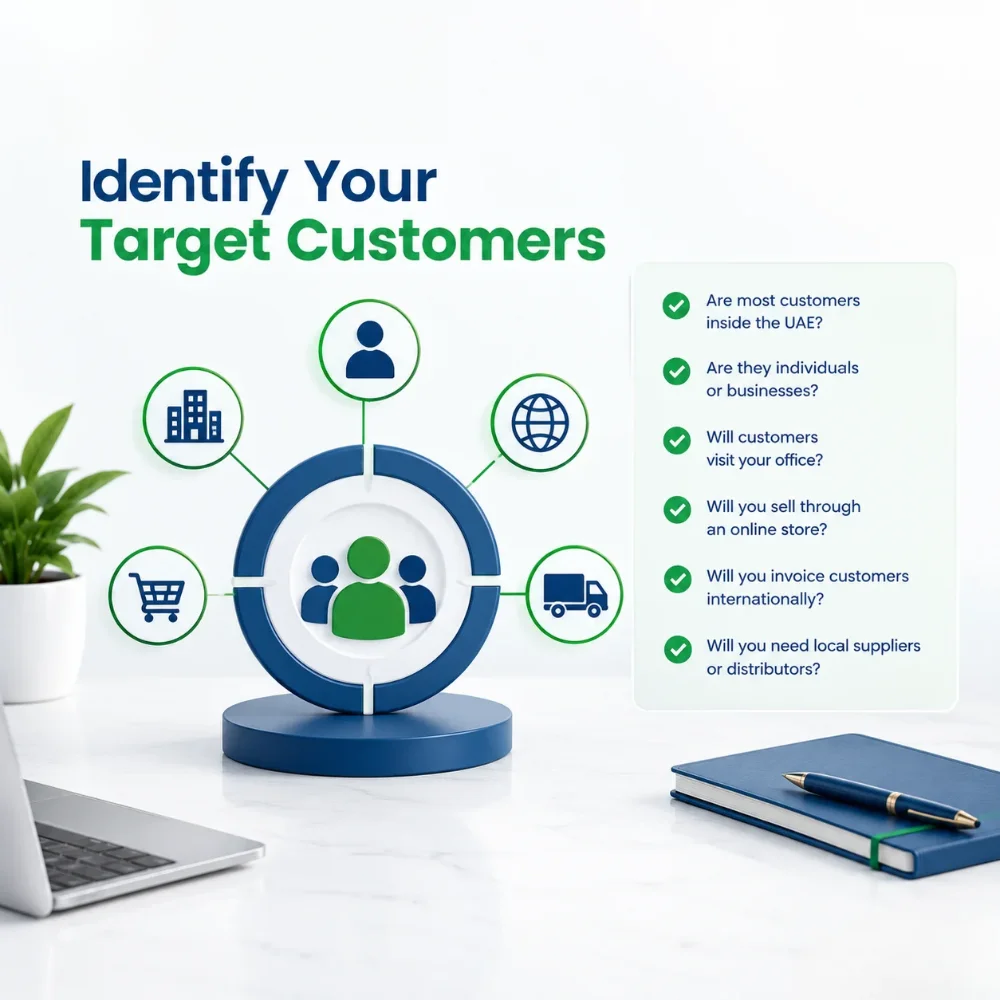
- Are most customers inside the UAE?
- Are they individuals or businesses?
- Will customers visit your office?
- Will you sell through an online store?
- Will you invoice customers internationally?
- Will you need local suppliers or distributors?
This step prevents founders from choosing a company structure first and trying to make the business model fit afterward.
3. Decide Between Mainland or Free Zone
One of the most important decisions in a small business setup UAE is choosing the appropriate jurisdiction. There is no single option that is automatically best for every founder. Mainland and free-zone structures can serve different business models, activities, and operating requirements.
When to Consider a Mainland Setup
A mainland setup may be worth evaluating when your business model depends heavily on operating in the UAE local market, serving local customers, or maintaining operations that require a mainland structure.
Your exact requirements depend on the business activity and applicable licensing rules.
When a Free Zone May Fit
A free zone may be worth considering when the selected authority supports your activity and your business model benefits from the services, infrastructure, workspace options, or other facilities offered by that zone.
Before choosing, compare:
- Business activity
- Customer location
- Licence options
- Office requirements
- Visa needs
- Setup and renewal costs
- Banking considerations
- Long-term operating plans
The UAE government’s official business portal provides separate information on doing business on the mainland and in free zones.
4. Choose the Correct Licence Type
Selecting a licence should be based on what the company actually does rather than simply choosing the cheapest available package. Depending on the business and authority, founders may encounter commercial, professional, industrial, e-commerce-related, or specialised licensing options.
Licence Selection Checklist
Before proceeding, confirm that:
- The licence covers your intended business activity.
- The selected jurisdiction permits that activity.
- Any required external approvals are identified.
- Office requirements are understood.
- Visa eligibility has been considered.
- Renewal and ongoing obligations are clear.
This is one of the most important UAE company formation requirements because an unsuitable licence can create operational problems later.
5. Build a Realistic UAE Business Setup Budget
A common mistake among small founders is budgeting only for the initial trade licence. Your actual setup budget should consider both one-time and recurring expenses.
Initial Costs May Include
- Company formation and licensing
- Government charges
- Initial visa-related costs, where applicable
- Establishment-related requirements
- Office or workspace costs
- Other approvals required for the activity
Recurring Costs May Include
- Licence renewal
- Office or workspace renewal
- Accounting and bookkeeping
- Tax compliance
- Employee-related costs
- Visa renewals
- Other regulatory requirements
The right question is not simply, “How much does a UAE licence cost?”
Instead, ask:
“How much money do I need to establish, operate, and maintain this business during its first year?”
That approach gives small founders a much more realistic picture of their financial readiness.
6. Check Your Office Requirements
Office requirements vary according to the business activity, jurisdiction, licensing authority, and selected setup. Some founders may need physical premises, while others may have access to workspace solutions that better match their early-stage operations.
Ask Before Choosing a Workspace
- Does my activity require physical premises?
- Can I use a flexible workspace?
- Will clients visit the office?
- How many employees will I have?
- How many visas might I need?
- Does the selected licence impose specific office requirements?
Do not pay for a larger office simply because it looks more established. At the same time, do not select a setup that fails to meet the requirements of your activity.
7. Estimate Your Visa Requirements
Visa planning should happen before company formation rather than after it.
A founder may need an investor or partner visa and may later require employee visas or family sponsorship. The applicable requirements depend on the company structure, jurisdiction, workspace, and other circumstances.
Create a Simple Visa Plan
List:
- Founder visas
- Employee visas
- Potential family sponsorship
- Expected number of employees
- Workspace requirements
- Establishment-related requirements
This helps prevent a common problem: selecting a company package without considering whether it supports the founder’s actual staffing and visa plans.
8. Prepare Your Founding Documents
Document preparation can reduce avoidable delays during company formation and later banking or tax processes. Depending on the legal form and authority, requirements can include identification documents, company information, applications, constitutional documents, and other supporting records.
Keep These Details Ready
- Passport copies
- Passport photographs where applicable
- Proposed business or trade name
- Business activity details
- Shareholder information
- Business plan where required
- Address or tenancy documents where applicable
- Corporate documents for entity shareholders, if relevant
Keep information consistent across your licence application, company documents, bank application, and tax records.
9. Think About Corporate Banking Before Registration
Obtaining a trade licence and opening a corporate bank account are separate processes. A bank may assess your business model, ownership, expected transactions, source of funds, customers, suppliers, and countries involved in your business.
Prepare to Explain Your Business
You should be able to clearly explain:
- What the company does
- Who your customers are
- How the company earns revenue
- Expected transaction volumes
- Source of funds
- Main suppliers
- Countries involved in transactions
- Ownership structure
For example, an online seller should be prepared to explain its sales channels, suppliers, payment methods, expected turnover, and customer markets.
Good banking preparation should therefore form part of your start a business in UAE checklist, rather than being treated as something to solve after receiving the licence.
10. Understand Tax and Compliance From the Beginning
Small founders should consider compliance before the company starts trading. VAT registration is mandatory for UAE businesses when the value of taxable supplies and imports exceeds the applicable mandatory threshold of AED 375,000, subject to the rules. Voluntary registration may be available above AED 187,500.
Corporate Tax requirements should also be considered according to the company’s circumstances.
Importantly for small businesses, the UAE Ministry of Finance announced in August 2026 that Small Business Relief has been extended for tax periods ending on or before 31 December 2029, subject to the relevant conditions. The announced threshold is annual revenue of up to AED 3 million.
Add These Compliance Questions to Your Checklist
- Do I need VAT registration?
- What are my Corporate Tax obligations?
- Do I need to maintain accounting records?
- Are UBO requirements applicable?
- Does my activity create AML obligations?
- When should bookkeeping begin?
- What business records should I retain?
Tax treatment depends on the company’s facts, so founders should verify their obligations rather than assume that being a small company automatically removes compliance responsibilities.
UAE Business Setup Checklist: Are You Ready?
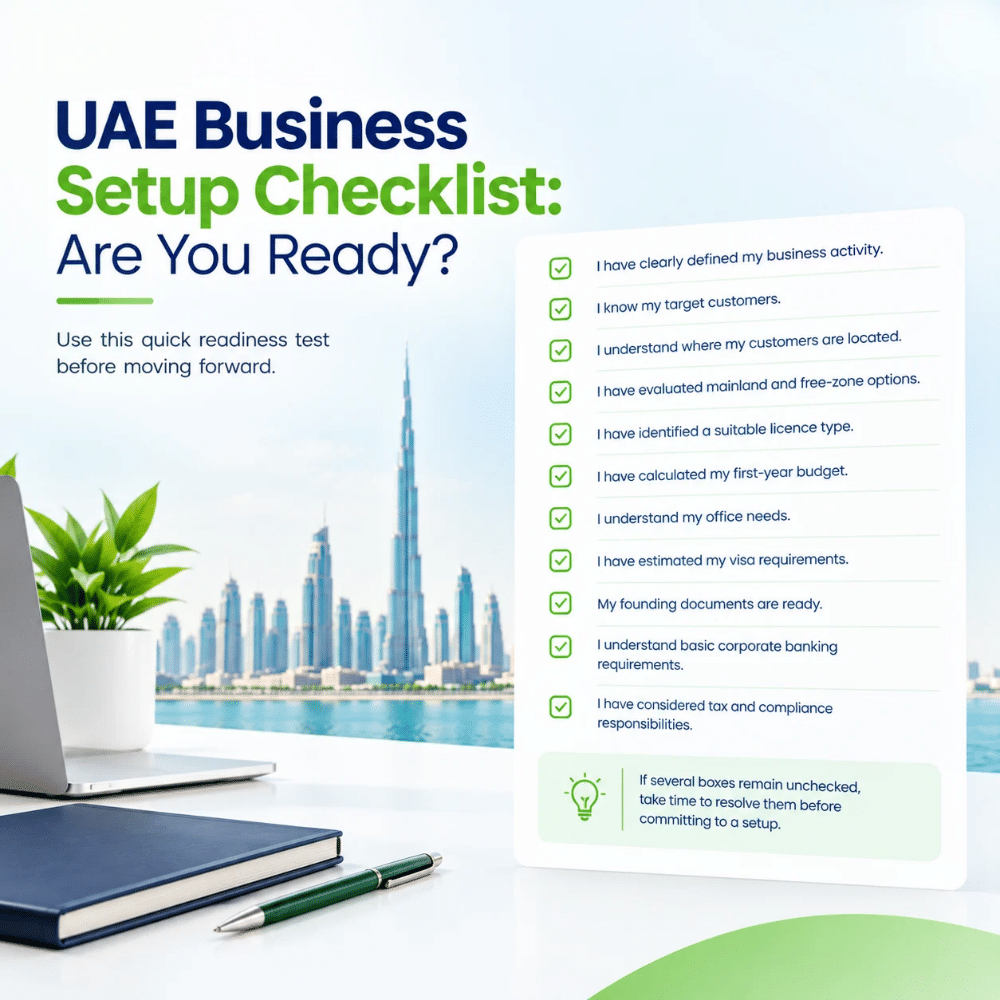
Use this quick readiness test before moving forward:
- I have clearly defined my business activity.
- I know my target customers.
- I understand where my customers are located.
- I have evaluated mainland and free-zone options.
- I have identified a suitable licence type.
- I have calculated my first-year budget.
- I understand my office needs.
- I have estimated my visa requirements.
- My founding documents are ready.
- I understand basic corporate banking requirements.
- I have considered tax and compliance responsibilities.
If several boxes remain unchecked, take time to resolve them before committing to a setup.
Common Mistakes Small Founders Make
Choosing the Cheapest Licence Without Checking the Activity
A low initial price does not make a licence suitable if it does not match the company’s actual activity.
Choosing the Jurisdiction Too Early
Do not choose mainland or free zone before understanding your customers, activity, office requirements, and operating model.
Budgeting Only for Formation
Your company will have recurring costs after incorporation. Include renewals, accounting, tax, workspace, visas, and other applicable expenses.
Assuming a Trade Licence Guarantees Banking
A company licence does not automatically mean that a bank will approve your corporate account. Banking institutions conduct their own assessment.
Delaying Bookkeeping
Waiting until tax deadlines approach can make records harder to reconstruct. Start maintaining proper financial records as the business begins operating.
Assuming Every Small Business Has the Same Requirements
A solo consultant, online retailer, software company, and trading business may have very different licensing and operational requirements.
UAE Business Setup Example: A Small Consulting Founder
Consider a founder who wants to establish a consulting company with UAE and international clients.
Instead of immediately selecting the cheapest company package, the founder should first:
- Define the exact consulting activity.
- Identify the main customer markets.
- Compare mainland and free-zone options.
- Confirm the appropriate licence.
- Calculate first-year setup and operating costs.
- Determine office requirements.
- Estimate founder and employee visa needs.
- Prepare identification and company documents.
- Prepare a clear banking profile.
- Set up bookkeeping and understand tax obligations.
This approach creates a more sustainable setup because each decision supports the actual business model.
How to Start a Business in UAE Without Overcomplicating the Process
A practical start a business in UAE checklist can follow six stages:
Step 1: Define
Clarify the business activity, customers, products or services, and revenue model.
Step 2: Compare
Evaluate mainland and free-zone options against your actual business requirements.
Step 3: Budget
Calculate initial setup expenses as well as recurring operating and compliance costs.
Step 4: Prepare
Collect founding documents and business information before submitting applications.
Step 5: Set Up
Complete the applicable licensing, company formation, and establishment procedures.
Step 6: Prepare to Operate
Organise banking, accounting, tax, visas, records, and ongoing compliance. The UAE also provides digital business-registration services, including the Basher service for eligible businesses.
When Should a Small Founder Get Professional Setup Guidance?
Professional guidance can be useful when the business involves a specialised activity, external approvals, multiple visas, complex ownership, international transactions, or uncertainty around mainland versus free-zone options.
The goal should not be to add unnecessary complexity. Good guidance should help you understand the available options, identify the requirements that actually apply to your business, and make decisions before you commit funds.
How Ripple Business Setup Can Help!
Ripple Business Setup helps UAE businesses navigate company formation, government procedures, licensing, banking preparation, and ongoing compliance requirements. We can help review your business activity, proposed setup structure, documents, and visa or quota requirements before you proceed.
For founders planning a UAE Business Setup, this preparation can make the process more organised and help avoid decisions based only on price or generic packages.
Phone: +971 50 593 8101
Email: info@ripplellc.ae
WhatsApp: +971 4 250 0833
Website: www.ripplellc.ae
FAQs
What should I check before starting a business in the UAE?
Start by defining your business activity, target customers, jurisdiction, licence type, budget, office needs, visa requirements, documents, banking plans, and compliance obligations.
What are the main UAE company formation requirements?
Requirements depend on the legal form, business activity, licensing authority, and jurisdiction. Founders should generally be prepared with identification, company information, proposed activity, ownership details, and any documents required by the relevant authority.
Is mainland or free zone better for a small business in the UAE?
Neither is automatically better. The right choice depends on the business activity, customer location, operating model, office requirements, visa needs, budget, and long-term plans.
How much should I budget for a small business setup in the UAE?
There is no single figure that applies to every company. Your budget should include formation and licensing costs plus workspace, visas, renewals, accounting, tax compliance, and other applicable operating expenses.
Do I need an office to start a business in the UAE?
Office requirements vary according to the business activity, jurisdiction and licensing authority. Some businesses may have flexible workspace options, while others may require specific premises.
Can I start a UAE business remotely?
Some company formation processes can be completed through digital channels or remotely, depending on the structure and authority. However, document, identity, visa, banking, or other requirements may still apply.
Does getting a UAE trade licence guarantee a corporate bank account?
No. A trade licence establishes the company but does not guarantee bank-account approval. Banks conduct their own due diligence and may request information about ownership, business activity, customers, source of funds, and expected transactions.
Final Takeaway
A successful UAE Business Setup starts with preparation, not paperwork. Before choosing a licence or paying for a formation package, make sure you understand your business activity, target customers, mainland or free-zone options, budget, office needs, visa requirements, documents, banking expectations, and compliance responsibilities.
For a small founder, the best setup is not necessarily the cheapest or fastest option. It is the structure that fits the way the business will actually operate and gives you a practical foundation for future growth.
Disclaimer: Business licensing, visa, tax, office, and compliance requirements can vary according to the business activity, legal structure, jurisdiction, and applicable UAE regulations. This article provides general information and should not be treated as legal or tax advice.