
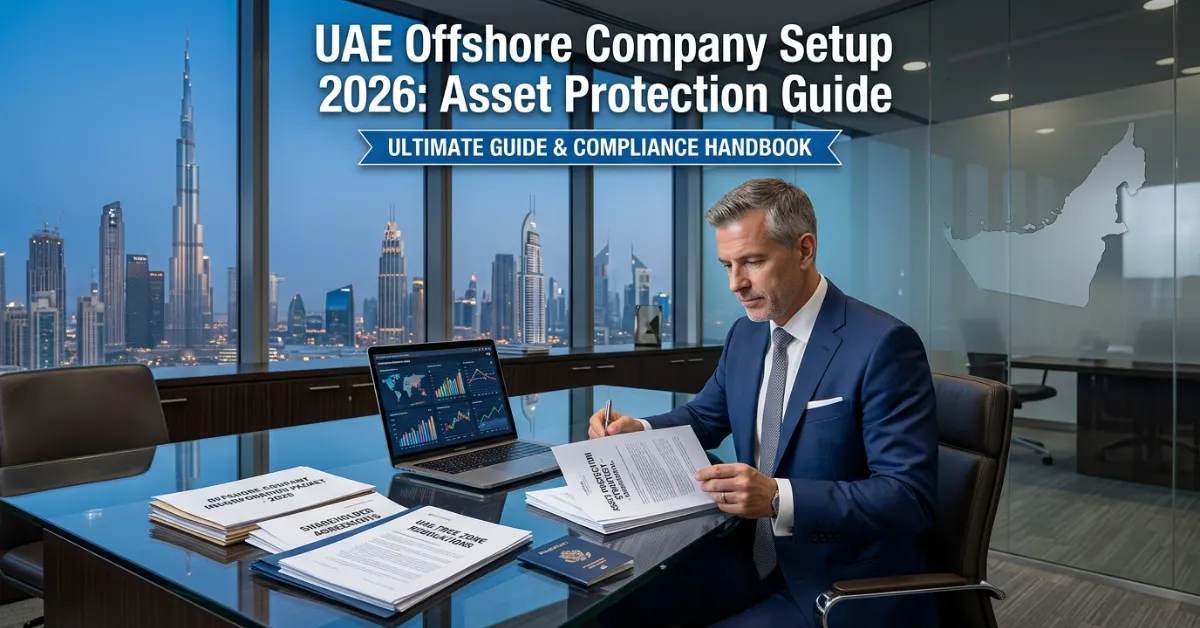
Setting up an offshore company in the UAE has become one of the most strategic moves for global investors, entrepreneurs, and high-net-worth individuals. Whether you want to protect personal assets, simplify international trade, or plan your estate efficiently, understanding how a UAE offshore company works and which jurisdiction fits your goals is the first step.
What is a UAE Offshore Company?
An offshore company in the UAE is a non-resident legal entity registered within a UAE-recognized jurisdiction but not permitted to conduct business activities inside the UAE itself. Think of it as a holding shell: you own it, it holds your assets, contracts, or intellectual property, but it operates internationally rather than locally.
The three main jurisdictions for offshore company UAE registrations are JAFZA Offshore (Jebel Ali Free Zone Authority, Dubai), RAK ICC (Ras Al Khaimah International Corporate Centre), and Ajman Offshore. Each carries distinct advantages in cost, privacy, and banking access, which we will cover in detail below.
Why Choose a UAE Offshore Company for Asset Protection in 2026?
- Protect personal assets from legal claims: Corporate structure separates personal liability from business risk
- Separate ownership from liabilities: Creditors targeting one entity cannot easily reach assets held in another entity
- Maintain confidentiality of ownership: Beneficial ownership registers in UAE offshore jurisdictions are not publicly accessible
- Tax efficiency: 0% corporate tax applies to offshore entities that do not operate inside the UAE (subject to applicable regulations)
- Estate planning and inheritance structuring: transfer of ownership shares can be pre-arranged to avoid succession disputes
The UAE continues to be one of the world’s leading offshore hubs in 2026, combining political stability, world-class banking infrastructure, and a regulatory framework that is increasingly transparent without sacrificing investor privacy. Its position between Europe, Asia, and Africa makes it uniquely attractive for cross-border wealth protection.
Key Benefits of UAE Offshore Company Setup
- 100% foreign ownership, no local sponsor required
- No minimum capital requirement in most offshore jurisdictions
- No physical office required; a registered agent address is sufficient
- Easy international banking access, UAE banks are globally recognized and widely accepted
- The fast setup process typically completes in 3 to 7 business days
In practice, these advantages make UAE offshore companies ideal for holding international real estate, managing IP portfolios, structuring joint ventures, and facilitating cross-border payments. A freelance digital entrepreneur, for instance, can hold their service contracts and revenue through an offshore vehicle, keeping operations lean and legally structured.
Top UAE Offshore Jurisdictions Compared (2026)

| Jurisdiction | Setup Cost (approx.) | Privacy Level | Banking Ease | Best For |
|---|---|---|---|---|
| JAFZA Offshore | AED 10,000–15,000+ | High | Excellent (Dubai banks) | Real estate holding, large corporates |
| RAK ICC | AED 5,000–8,000+ | High | Good | SMEs, startups, international trade |
| Ajman Offshore | AED 4,000–6,000+ | Moderate–High | Moderate | Budget-conscious setups, asset holding |
JAFZA suits investors who need direct access to Dubai’s banking ecosystem and are holding high-value UAE properties. RAK ICC is the most popular choice for entrepreneurs and SMEs due to its cost efficiency and flexible structure. Ajman Offshore fits those with simpler requirements and tighter budgets. Your final choice should depend on your banking needs, the nature of assets, and long-term business plans.
Who Should Set Up a UAE Offshore Company?
- International investors looking to hold multi-country portfolios under a single structure
- Real estate holding owners want to simplify ownership transfer and reduce personal exposure
- E-commerce and digital entrepreneurs processing international payments and IP ownership
- High-net-worth individuals planning wealth transfer across generations
- Business owners expanding globally who need a neutral, credible holding entity
As a practical example, a Pakistani or Indian national with properties in Dubai and business interests in Europe would benefit significantly from a JAFZA or RAK ICC offshore company consolidating ownership, enabling clean exit strategies, and insulating personal wealth from any single country’s legal system.
Step-by-Step Process to Set Up a UAE Offshore Company (2026 Guide)
- Choose your jurisdiction (JAFZA, RAK ICC, or Ajman) based on your needs and budget
- Select a unique company name and confirm availability with the relevant authority
- Submit required documents, typically passport copies, proof of address, and business activity details
- Appoint a licensed registered agent (mandatory for all UAE offshore setups)
- Open an offshore bank account with a UAE or international bank
- Receive incorporation documents, certificate of incorporation, Memorandum of Association, and share certificates
The entire process typically takes 3 to 7 business days once all documents are in order. Bank account opening may add 2 to 4 weeks, depending on the institution’s due diligence process.
Documents Required for UAE Offshore Company Formation
- Passport copies of all shareholders and directors
- Proof of residential address (utility bill or bank statement, no older than 3 months)
- Bank reference letter from your existing bank
- Description of business activities or intended use of the company
Keep your documents current and professionally translated if they are not in English or Arabic. Incomplete submissions are the most common cause of delays.
UAE Offshore Company vs Free Zone vs Mainland (Key Differences)
| Feature | Offshore | Free Zone | Mainland |
|---|---|---|---|
| Business activity in UAE | Not permitted | Anywhere in the UAE | Business activity in the UAE |
| Office requirement | Not required | Usually required | Required |
| Visa eligibility | Not available | Available | Available |
| Foreign ownership | 100% | 100% | Up to 100% (since 2021 reforms) |
| Corporate tax | 0% (offshore income) | 9% (profits above AED 375K) | 9% (profits above AED 375K) |
Offshore is the right choice when your goal is asset holding, wealth protection, or international trade, not operating a local business in the UAE. If you need UAE residency, client meetings, or a local business address, a free zone or mainland license serves better.
Cost of UAE Offshore Company Setup in 2026
- Government/authority registration fees: AED 2,500–7,000 depending on jurisdiction
- Registered agent fees: AED 2,000–5,000 annually
- Bank account setup charges: vary by bank; some charge AED 0–500 for initial setup
Total first-year costs typically fall between AED 5,000 and AED 15,000, depending on the jurisdiction and service provider. Annual renewal costs are generally lower. Prices vary significantly between consultants, so always request a full cost breakdown before committing.
Compliance and Regulations You Must Know
UAE offshore companies are not a regulatory grey area they operate under defined rules, and non-compliance carries consequences.
- Economic Substance Regulations (ESR): certain activity types must demonstrate economic substance in the UAE. Most pure holding companies are either exempt or have minimal requirements
- Anti-Money Laundering (AML) rules: beneficial ownership information must be maintained, even if not publicly disclosed. Banks will conduct Know Your Customer (KYC) checks
- Annual renewal: offshore licenses must be renewed each year, and registered agent agreements must remain active
Staying compliant is straightforward if you work with a qualified agent and maintain accurate records from the start.
Common Mistakes to Avoid When Setting Up an Offshore Company
- Choosing the wrong jurisdiction a mismatch between your banking needs and the jurisdiction’s banking relationships, causes months of delays
- Ignoring compliance rules, overlooking ESR or AML obligations can result in fines or deregistration
- Poor banking planning, not all banks accept offshore entities; research compatibility before incorporation
- Not using a reliable consultant, DIY setups often produce errors in constitutional documents that are expensive to correct
UAE Offshore Company Banking: What You Need to Know

Banking is arguably the most challenging aspect of UAE offshore company setup. Not every bank accepts offshore entities, and those that do require thorough documentation: a clear business model, source-of-funds explanation, reference letters, and, in some cases, an in-person interview. JAFZA offshore companies tend to have the easiest time with major Dubai banks. RAK ICC entities are accepted by several mid-tier and international banks. The key to smooth account opening is preparation of clear corporate documents, a clean personal banking history, and a concise explanation of what the company does and where its income originates.
Is a UAE Offshore Company Still Worth It in 2026?
Global transparency standards, including OECD’s Common Reporting Standard (CRS) and the UAE’s own corporate tax framework, have changed the offshore landscape. But they have not eliminated its value. What they have eliminated is misuse: offshore companies designed purely for tax evasion face greater scrutiny. For legitimate asset protection, estate planning, and international business structuring, a UAE offshore company remains a highly effective tool in 2026. The UAE’s combination of zero income tax, strong legal infrastructure, and international credibility keeps it ahead of comparable offshore destinations.
The right offshore structure, built correctly and maintained in compliance, still delivers significant advantages for investors who take a long-term, legitimate approach to wealth management.
How Ripple Business Setup Can Help You
Setting up a UAE offshore company can feel complex if you are new to compliance and jurisdiction rules. Ripple Business Setup simplifies the process by handling documentation, jurisdiction selection, and banking support. Their team guides you at every step to ensure your company is structured correctly for asset protection and long-term growth.
Ripple Business Setup – documentation, jurisdiction selection, banking support
- +971 50 593 8101
- info@ripplellc.ae
- +971 4 250 0833
Conclusion
A UAE offshore company is one of the most powerful tools available to investors and entrepreneurs seeking structured, compliant asset protection in 2026. From shielding property holdings to simplifying international business operations, the benefits are real, provided you choose the right jurisdiction, maintain compliance, and work with experienced professionals. The UAE’s stability, banking infrastructure, and tax-neutral environment continue to make it a global leader for offshore structuring. If you are considering this route, expert guidance from day one will save both cost and complexity in the long run.
Disclaimer: This article is for informational purposes only and does not constitute legal or financial advice. Regulations may change, so consult a qualified business advisor before making any decisions.