

Introduction
Depreciation schedules play a vital role in maintaining accurate financial records for businesses across the UAE. Whether you operate a startup, SME, or large enterprise, tracking the value of fixed assets over time is essential for financial reporting, budgeting, tax compliance, and informed decision-making. A well-maintained depreciation schedule helps businesses allocate the cost of long-term assets throughout their useful lives instead of recording the entire expense at the time of purchase.
In UAE accounting, depreciation is more than just an accounting calculation. It supports compliance with International Financial Reporting Standards (IFRS), improves the accuracy of financial statements, and helps businesses prepare for audits and corporate tax obligations. As companies invest in office equipment, machinery, vehicles, technology, and commercial property improvements, keeping an updated depreciation schedule ensures these assets are recorded correctly throughout their lifecycle.
What Is a Depreciation Schedule?
A depreciation schedule is a financial document that tracks how the value of a fixed asset decreases over its useful life. Instead of recognizing the entire purchase cost as an expense immediately, businesses spread that cost across several accounting periods.
This schedule enables organizations to monitor every depreciable asset, calculate annual depreciation expenses, determine accumulated depreciation, and identify the remaining book value. It also supports accurate financial reporting and ensures consistency in accounting practices.
A depreciation schedule is commonly prepared for assets such as machinery, office furniture, computers, company vehicles, manufacturing equipment, and leasehold improvements.
Information Included in a Depreciation Schedule
A complete depreciation schedule typically contains:
- Asset name and description
- Asset identification number
- Purchase date
- Purchase cost
- Residual (salvage) value
- Estimated useful life
- Selected depreciation method
- Annual depreciation expense
- Accumulated depreciation
- Net book value
- Asset disposal details (if applicable)
Keeping this information updated allows businesses to monitor assets throughout their lifecycle while supporting audits and financial reviews.
Why Depreciation Schedules Are Important in UAE Accounting
Depreciation schedules are an essential component of professional accounting because they provide a structured approach to recording long-term business assets. Rather than relying on estimates or outdated spreadsheets, companies maintain accurate financial information that reflects the real value of their assets.
One of the biggest advantages is improved financial reporting. Recording depreciation annually ensures expenses are matched with the revenue those assets help generate. This results in more realistic profit figures and reliable financial statements.
Depreciation schedules also improve asset valuation. As equipment, machinery, and office assets age, their book value changes. Businesses can easily identify current asset values for insurance purposes, financing applications, mergers, acquisitions, or business valuations.
Another significant benefit is improved budgeting. Understanding when assets will reach the end of their useful lives helps management plan future capital expenditures and avoid unexpected replacement costs.
From an audit perspective, organized depreciation schedules demonstrate transparency and proper financial management. Auditors can verify asset records quickly, reducing delays during financial reviews.
Overall, depreciation schedules contribute to:
- Accurate financial statements
- Better budgeting decisions
- Improved asset management
- Easier financial audits
- Reliable business valuations
- Enhanced investor confidence
- Stronger internal controls
UAE Accounting Standards for Depreciation
Businesses operating in the UAE generally prepare financial statements in accordance with International Financial Reporting Standards (IFRS). One of the most important standards governing depreciation is IAS 16 – Property, Plant and Equipment.
IAS 16 requires businesses to recognize fixed assets at cost and depreciate them systematically over their expected useful lives. The depreciation method should reflect how the asset’s economic benefits are consumed by the business.
Companies are also expected to review useful life estimates and residual values regularly. If circumstances change, depreciation calculations should be updated accordingly to ensure financial statements remain accurate.
Consistent application of accounting policies is another important requirement. Businesses should apply the same depreciation methods to similar categories of assets unless a justified reason exists for making changes.
What UAE Businesses Must Follow
To maintain compliance, businesses should:
- Follow IFRS accounting standards
- Maintain a complete fixed asset register
- Keep purchase invoices and supporting documentation
- Assign realistic useful lives to assets
- Review residual values annually
- Apply consistent depreciation methods
- Update depreciation schedules every financial year
- Record asset disposals promptly
- Retain documentation for audit purposes
Following these practices improves compliance while supporting transparent financial reporting.
Common Depreciation Methods Used in UAE Businesses
Selecting the right depreciation method depends on the nature of the asset and how it generates economic value. Different industries may prefer different approaches based on operational requirements.
Straight-Line Depreciation
The straight-line method is the simplest and most commonly used depreciation technique. Under this approach, the same depreciation expense is recorded every year throughout the asset’s useful life.
Formula:
Annual Depreciation = (Cost − Residual Value) ÷ Useful Life
For example, if a business purchases office furniture for AED 50,000 with a useful life of 10 years and an estimated residual value of AED 5,000, the annual depreciation expense would be AED 4,500.
This method is ideal for:
- Office furniture
- Computers
- Office equipment
- Buildings
- General business assets
Reducing Balance Method
The reducing balance method applies a fixed depreciation percentage to the asset’s remaining book value each year. As a result, higher depreciation expenses are recognized during the early years, with lower expenses recorded later.
This method is often suitable for assets that lose value more quickly during the initial years of use.
Examples include:
- Company vehicles
- Manufacturing equipment
- Technology assets
- Specialized machinery
Units of Production Method
The units of production method bases depreciation on actual usage instead of time. Businesses depreciate assets according to the number of units produced or hours operated. This approach is particularly useful for manufacturing companies where equipment wear depends on production levels rather than age.
For example, if a machine is expected to produce one million units during its lifetime, depreciation is calculated based on actual production each year.
This method provides highly accurate cost allocation for production-based businesses.
How Depreciation Schedules Affect UAE Corporate Tax
The introduction of UAE Corporate Tax has increased the importance of maintaining accurate depreciation schedules. While accounting depreciation is recorded under International Financial Reporting Standards (IFRS), businesses may need to make tax adjustments depending on applicable corporate tax regulations. Keeping detailed depreciation records helps companies calculate taxable income accurately and demonstrate compliance during tax reviews.
A well-maintained depreciation schedule provides clear evidence of when an asset was purchased, its original cost, useful life, depreciation method, accumulated depreciation, and current book value. This information becomes valuable when preparing corporate tax returns, supporting tax computations, or responding to inquiries from the Federal Tax Authority (FTA).
Businesses that fail to maintain proper fixed asset records may encounter difficulties reconciling accounting profits with taxable profits. Incomplete documentation can also increase the risk of compliance issues during audits.
Another important consideration is asset disposal. When a business sells or retires an asset, the depreciation schedule helps determine its carrying amount and any resulting gain or loss. This ensures accurate accounting treatment and proper tax reporting.
Key Tax Considerations
- Maintain a complete fixed asset register.
- Keep purchase invoices and payment records.
- Record accumulated depreciation annually.
- Update depreciation schedules after asset additions or disposals.
- Retain supporting documentation for tax audits.
- Review accounting policies regularly for consistency.
- Reconcile depreciation balances with financial statements.
Fixed Assets That Require Depreciation
Most long-term business assets lose value over time because of wear and tear, technological changes, or regular use. These assets should generally be included in a depreciation schedule.
Assets Commonly Depreciated
- Office furniture
- Office equipment
- Computers and laptops
- Printers and networking devices
- Company vehicles
- Manufacturing machinery
- Production equipment
- Warehouse shelving
- Leasehold improvements
- Storage systems
- IT infrastructure
- Air conditioning systems
- Security systems
- Commercial equipment
- Factory machinery
Maintaining accurate records for these assets allows businesses to monitor replacement needs, control capital expenditure, and prepare reliable financial statements.
Step-by-Step Process to Create a Depreciation Schedule
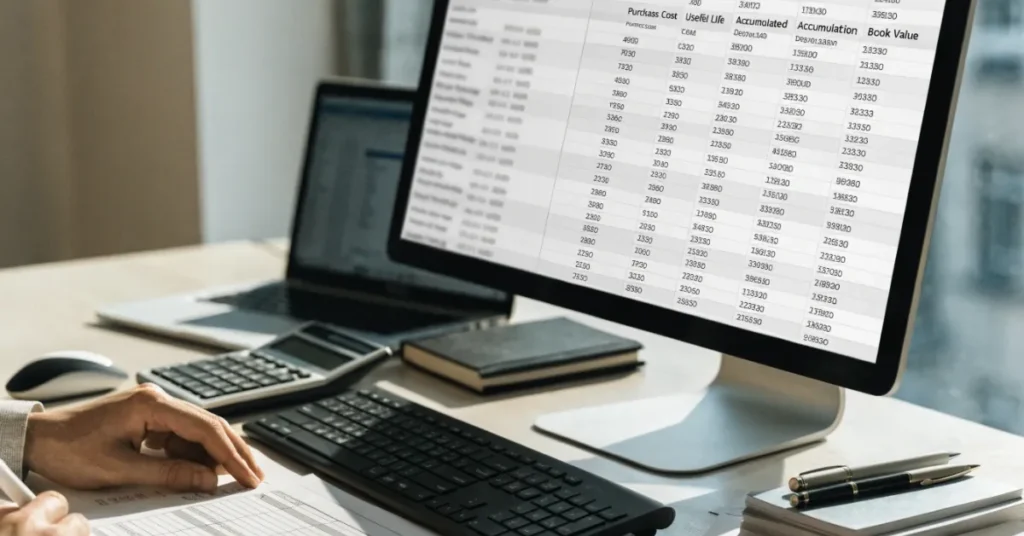
Creating a depreciation schedule is straightforward when businesses follow a structured process.
Step 1: Identify Fixed Assets
Begin by listing every long-term asset owned by the business. Include only assets expected to provide economic benefits for more than one accounting period.
Examples include vehicles, machinery, computers, furniture, and office equipment.
Step 2: Record Purchase Cost
Document the acquisition cost of each asset. The recorded cost should include the purchase price along with any directly attributable expenses such as transportation, installation, customs duties, or setup costs.
Accurate cost recording forms the foundation of reliable depreciation calculations.
Step 3: Determine Useful Life
Estimate how long each asset will remain productive for business operations. Useful life varies depending on the asset type, expected usage, maintenance practices, and manufacturer recommendations.
Businesses should review useful life estimates periodically to ensure they remain realistic.
Step 4: Estimate Residual Value
Residual value represents the estimated amount the business expects to receive when disposing of the asset at the end of its useful life.
A realistic residual value improves the accuracy of depreciation calculations.
Step 5: Choose the Appropriate Depreciation Method
Select a depreciation method that best reflects how the asset’s economic benefits are consumed.
For example:
- Straight-line method for office assets
- Reducing balance for vehicles and technology
- Units of production for manufacturing equipment
Consistency across similar asset categories is important for financial reporting.
Step 6: Calculate Annual Depreciation
Apply the selected depreciation formula to calculate the annual depreciation expense.
The calculated amount is recorded in the profit and loss statement while accumulated depreciation is reflected on the balance sheet.
Updating these calculations each financial year ensures accurate reporting.
Step 7: Review and Update the Schedule Every Year
A depreciation schedule should never remain static.
Businesses should update it whenever they:
- Purchase new assets
- Sell existing assets
- Dispose of obsolete equipment
- Revise useful life estimates
- Change residual values
- Perform major capital improvements
Annual reviews help maintain compliance with accounting standards and improve financial accuracy.
Common Mistakes Businesses Make with Depreciation Schedules
Many businesses make avoidable mistakes that reduce the reliability of their financial statements. Understanding these common errors helps organizations strengthen their accounting practices. One frequent mistake is assigning unrealistic useful lives to assets. Overestimating or underestimating an asset’s lifespan leads to inaccurate depreciation expenses and distorted financial results.
Another issue is failing to update depreciation schedules after purchasing or disposing of assets. Businesses sometimes continue depreciating assets that have already been sold or retired, creating unnecessary discrepancies.
Some companies also confuse routine maintenance expenses with capital expenditures. While maintenance costs are generally expensed immediately, significant improvements that extend an asset’s useful life should usually be capitalized.
Manual spreadsheets can also increase the risk of calculation errors, duplicate entries, and missing assets.
Common Errors
- Incorrect useful life estimates
- Wrong depreciation method selection
- Failure to record new assets
- Missing asset disposals
- Outdated depreciation schedules
- Poor documentation
- Inconsistent accounting policies
- Manual calculation mistakes
- Failure to review residual values
- Mixing repairs with capital expenditure
Avoiding these mistakes helps businesses maintain reliable financial records and prepare confidently for audits.
Benefits of Maintaining Accurate Depreciation Schedules
An accurate depreciation schedule provides much more than compliance. It becomes a valuable management tool that supports financial planning, budgeting, and strategic decision-making.
Reliable depreciation records improve the accuracy of both the balance sheet and profit and loss statement. Management gains a clearer understanding of business performance because asset costs are allocated fairly across accounting periods.
Depreciation schedules also make annual audits significantly easier. Auditors can verify asset values, depreciation calculations, and supporting documents without lengthy reconciliation processes.
Lenders and investors also prefer businesses with organized financial records. Clear depreciation schedules demonstrate sound financial management and strengthen credibility during funding discussions.
Key Benefits
- Accurate financial reporting
- Better budgeting and forecasting
- Improved cash flow planning
- Easier external audits
- Stronger tax compliance
- Enhanced asset management
- Accurate business valuation
- Better investment decisions
- Improved financing opportunities
- Reduced compliance risks
- Greater management confidence
- Transparent financial records
Real UAE Business Example
A Dubai-based trading company invested in several fixed assets, including delivery vans, warehouse shelving, office furniture, desktop computers, and barcode scanning equipment. Initially, the business recorded these purchases but did not maintain a structured depreciation schedule. As the company expanded, management found it difficult to determine the current value of its assets, forecast replacement costs, and prepare accurate financial reports.
During the annual financial audit, the company spent considerable time locating invoices, verifying purchase dates, and recalculating depreciation manually. This delayed the audit process and increased administrative costs.
To improve financial management, the company implemented a comprehensive fixed asset register and created detailed depreciation schedules for every depreciable asset. Each record included the purchase date, acquisition cost, estimated useful life, residual value, depreciation method, annual depreciation expense, accumulated depreciation, and net book value.
Within a year, the business experienced several measurable improvements:
- Faster year-end financial reporting
- Simplified audit preparation
- More accurate balance sheet values
- Better budgeting for future asset replacements
- Improved financial transparency
- Stronger compliance with IFRS accounting requirements
- Easier corporate tax record management
This example demonstrates how maintaining accurate depreciation schedules supports better financial decision-making while reducing compliance risks.
Best Practices for Managing Depreciation Schedules

Effective depreciation management requires consistency, regular reviews, and organized documentation. Businesses that establish clear accounting procedures can improve financial accuracy and reduce administrative challenges.
Some of the most effective practices include maintaining a complete fixed asset register, reviewing useful lives annually, retaining purchase invoices, and using reliable accounting software to automate depreciation calculations.
Best Practices
- Maintain a detailed fixed asset register.
- Assign unique identification numbers to each asset.
- Keep all purchase invoices and supporting documents.
- Select depreciation methods that reflect actual asset usage.
- Review useful lives and residual values annually.
- Record new asset purchases immediately.
- Update schedules after disposals or replacements.
- Reconcile depreciation balances with financial statements.
- Follow IFRS accounting standards consistently.
- Perform regular internal reviews of asset records.
- Use accounting software to minimize manual errors.
- Consult qualified accounting professionals when necessary.
Tools That Help Manage Depreciation Schedules
Technology has made fixed asset management much easier for businesses of all sizes. Modern accounting software can automate depreciation calculations, generate asset reports, and maintain complete audit trails.
Accounting Software
Popular accounting solutions include:
- QuickBooks
- Xero
- Zoho Books
- TallyPrime
- Microsoft Dynamics 365 Business Central
- Oracle NetSuite
These platforms allow businesses to calculate depreciation automatically, generate financial reports, and monitor fixed assets efficiently.
Spreadsheet Templates
Small businesses with a limited number of assets may use spreadsheet templates during the early stages of growth. However, spreadsheets require manual updates and carry a higher risk of calculation errors.
ERP Systems
Larger organizations often implement Enterprise Resource Planning (ERP) systems that integrate accounting, procurement, inventory, and fixed asset management into one centralized platform. This provides greater control over asset tracking and financial reporting.
Depreciation Schedule Checklist
Use the following checklist to ensure your depreciation schedule remains complete and compliant:
✔ Fixed asset register is updated.
✔ All purchase invoices are securely maintained.
✔ Asset costs are accurately recorded.
✔ Useful life estimates are reviewed regularly.
✔ Residual values are realistic.
✔ Depreciation methods are applied consistently.
✔ Annual depreciation calculations are updated.
✔ Accumulated depreciation balances are reconciled.
✔ Asset disposals are recorded promptly.
✔ Capital improvements are properly documented.
✔ Financial statements match depreciation records.
✔ Audit documentation is organized and accessible.
Why Choose Ripple Business Setup for UAE Accounting and Financial Compliance?
Managing depreciation schedules accurately is only one part of maintaining compliant financial records in the UAE. Businesses also need reliable accounting support, bookkeeping, corporate tax assistance, VAT compliance, and financial reporting to stay aligned with UAE regulations and IFRS standards. Ripple Business Setup provides comprehensive accounting and business support services, helping startups, SMEs, and established companies maintain accurate financial records, manage fixed assets, prepare financial statements, and meet their compliance obligations with confidence.
For professional assistance with depreciation schedules, bookkeeping, accounting, VAT, corporate tax, and business setup services in the UAE, contact Ripple Business Setup at +971 50 593 8101, email info@ripplellc.ae, or WhatsApp +971 4 250 0833. Our experienced team is ready to help your business maintain accurate financial records and achieve long-term compliance.
FAQ
Is depreciation mandatory for UAE businesses?
Businesses that prepare financial statements under IFRS should depreciate eligible fixed assets systematically over their useful lives to ensure accurate financial reporting.
Which depreciation method is most commonly used?
The straight-line method is the most widely used because it is simple, consistent, and suitable for many types of business assets.
Does depreciation reduce corporate tax?
Depreciation affects accounting profits, while tax treatment depends on applicable UAE Corporate Tax regulations and any required tax adjustments.
How often should depreciation schedules be updated?
Businesses should review and update depreciation schedules at least once each financial year and whenever assets are purchased, sold, or significantly improved.
What assets are not depreciated?
Assets with an indefinite useful life, such as land, are generally not depreciated. However, buildings, equipment, furniture, vehicles, and machinery are usually depreciable.
Can the useful life of an asset be changed?
Yes. If new information indicates that an asset will last longer or shorter than originally estimated, businesses should revise the useful life in accordance with applicable accounting standards.
Is a depreciation schedule required during audits?
Yes. Auditors commonly review depreciation schedules to verify asset values, depreciation calculations, and supporting documentation.
Which accounting software can calculate depreciation automatically?
Most modern accounting platforms, including QuickBooks, Xero, Zoho Books, TallyPrime, Microsoft Dynamics 365 Business Central, and Oracle NetSuite, provide automated depreciation features.
Conclusion
Depreciation schedules are an essential part of professional UAE accounting. They help businesses allocate the cost of fixed assets accurately, maintain reliable financial statements, and comply with IFRS requirements. Organized depreciation records also support budgeting, financial planning, asset management, and audit readiness.
Whether you operate a startup, an SME, or a large enterprise, maintaining an up-to-date depreciation schedule improves transparency and enables better financial decision-making. It also simplifies year-end reporting and strengthens overall financial controls.
Disclaimer: This article is intended for general informational purposes only and should not be considered accounting, tax, or legal advice. Businesses should consult qualified accounting or tax professionals for guidance tailored to their specific circumstances and to ensure compliance with applicable UAE laws and regulations.