
Introduction
The UAE has become one of the most attractive global hubs for entrepreneurs, startups, and international investors. One of the main reasons is its flexible business setup structure, especially the option of Free Zone and Mainland companies.
However, as businesses grow, many entrepreneurs realize a limitation: a Free Zone company is restricted in directly trading within the UAE Mainland market without additional approvals. This is where the concept of Dual Licensing becomes important.
What is Dual Licensing in UAE?
Dual Licensing is a business arrangement that allows a Free Zone-registered company to operate in the UAE Mainland under an additional license issued by the relevant Mainland authority, such as the Department of Economy & Tourism (DET) in Dubai.
Instead of forming a separate Mainland entity, the company keeps its Free Zone structure while gaining legal permission to operate in the Mainland market.
Key points of Dual Licensing:
- The company remains registered in a Free Zone
- A Mainland license is issued for specific business activities
- No need to create a new legal entity
- Operations are legally recognised in both jurisdictions
This model is especially useful for businesses that want to maintain Free Zone benefits (like 100% foreign ownership) while accessing the wider UAE customer base.
How Dual Licensing Works (Step-by-Step Process)
Understanding the process helps avoid delays and compliance issues.
Step 1: Check Free Zone Eligibility
Not all Free Zones allow dual licensing. The company must be registered in an approved Free Zone jurisdiction.
Step 2: Business Activity Alignment
The Mainland license must match or align with the existing Free Zone business activity.
Step 3: Apply for Mainland Approval
The entrepreneur submits an application to the relevant Mainland authority (e.g., DET in Dubai).
Step 4: Obtain Required Approvals
Regulatory approvals are reviewed based on:
- Business activity
- Ownership structure
- Compliance status
Step 5: Office Requirement Fulfilment
In many cases, a physical office or flexi-desk arrangement in the Mainland is required.
Step 6: License Issuance
Once approved, the Mainland license is issued, enabling legal operations across both zones.
Difference Between Free Zone, Mainland, and Dual Licensing
Understanding these structures is essential before choosing an expansion model.
Free Zone Company
- 100% foreign ownership
- Tax benefits and simplified setup
- Restricted direct Mainland trading
Mainland Company
- Full access to UAE local market
- Ability to trade anywhere in UAE
- Requires compliance with UAE commercial laws
Dual Licensing Model
- Hybrid structure combining both systems
- Keeps Free Zone registration active
- Adds Mainland operational permission
- No need for a separate company
Comparison Summary
- Free Zone = Global + restricted local access
- Mainland = Full local access
- Dual Licensing = Both combined efficiently
Benefits of Dual Licensing for Business Expansion
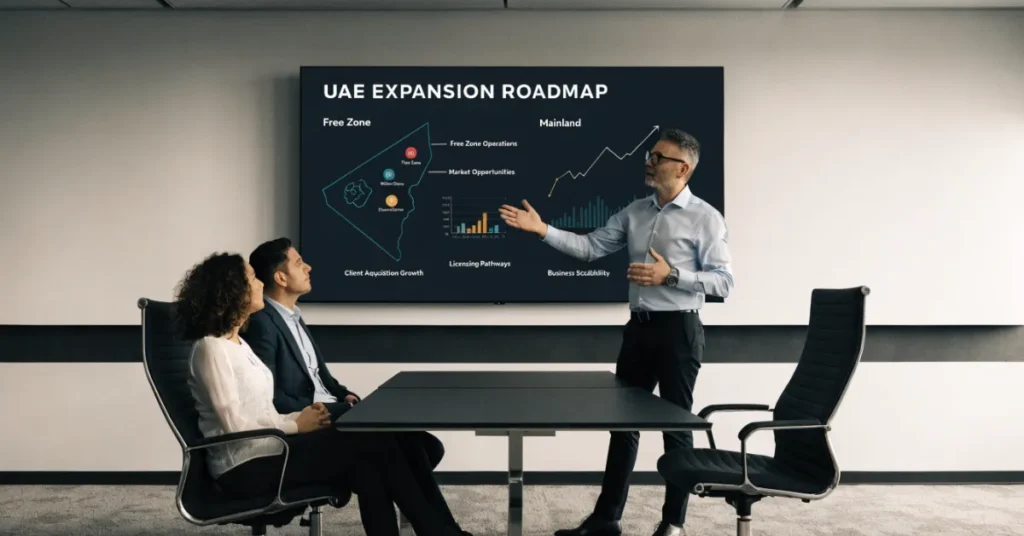
Dual Licensing is becoming increasingly popular due to its strategic advantages.
Key benefits include:
- Access to UAE Mainland clients without restructuring
- Cost savings compared to setting up a new company
- Faster market entry and business scalability
- Ability to maintain Free Zone tax and ownership benefits
- Improved credibility with local UAE businesses and government clients
It also reduces administrative burden since businesses operate under a streamlined structure instead of managing multiple entities.
Eligibility Criteria for Dual Licensing in UAE
Not every company can apply for Dual Licensing. Several conditions apply:
- The Free Zone must support dual licensing
- Business activity must be approved for Mainland operation
- The company must maintain good regulatory standing
- A valid Mainland office address may be required
- Some regulated sectors may need additional approvals
Certain industries like consulting, IT services, and trading are more likely to qualify.
Required Documents for Dual Licensing
To apply for Dual Licensing, businesses typically need:
- Valid Free Zone trade license copy
- Passport copies of shareholders
- Emirates ID (if applicable)
- No Objection Certificate (NOC) from Free Zone Authority
- Business activity details
- Tenancy contract or office lease in Mainland (if required)
Having documents prepared in advance helps reduce processing delays.
Challenges and Limitations of Dual Licensing
While Dual Licensing is highly beneficial, it also comes with some limitations.
Common challenges include:
- Not all Free Zones support dual licensing
- Certain business activities may be restricted
- Additional compliance requirements from Mainland authorities
- Potentially higher operational costs
- Approval timelines may vary depending on the sector
Businesses should carefully evaluate their long-term strategy before choosing this model.
Cost of Dual Licensing in UAE (What Businesses Should Expect)
The cost of Dual Licensing varies based on multiple factors.
Key cost components:
- Mainland license registration fees
- Free Zone renewal costs
- Office rent or flexi-desk charges
- Government approval fees
- Activity-specific charges
Costs are not fixed and may vary depending on the emirate, Free Zone, and business activity. Some sectors require higher compliance, increasing overall expenses.
Real Case Example – Free Zone Company Expanding to Mainland

Consider a marketing consultancy registered in a UAE Free Zone. Initially, the company served international clients only. However, after gaining traction, it began receiving inquiries from Mainland UAE businesses.
Instead of forming a new Mainland company, the business opted for Dual Licensing.
Outcome:
- Access to local UAE corporate clients increased
- Revenue grew due to expanded market reach
- Operational costs remained controlled
- No need for restructuring or liquidation
This example shows how Dual Licensing supports growth without disrupting existing operations.
Common Mistakes Businesses Make During Expansion
Many companies face challenges because of avoidable mistakes:
- Choosing a Free Zone that does not support dual licensing
- Ignoring Mainland compliance requirements
- Underestimating office space requirements
- Failing to align business activities correctly
- Not planning long-term expansion strategy
Proper planning and professional guidance can prevent these issues.
Dual Licensing vs Branch Office Setup – Which is Better?
Both options support expansion, but they serve different needs.
Dual Licensing:
- Keeps the original Free Zone company active
- Faster and simpler setup
- Cost-effective for SMEs
Branch Office:
- Extension of the parent company
- More regulatory involvement
- Better suited for large corporations
Conclusion:
For most SMEs and startups, Dual Licensing offers a more flexible and efficient solution.
Future of Dual Licensing in UAE Business Environment
The UAE government continues to improve business regulations to attract global investors. Dual Licensing is expected to become even more accessible due to:
- Increased business-friendly reforms
- Digital licensing systems
- Greater Free Zone and Mainland integration
- Support for SMEs and startups
This evolution aligns with the UAE’s vision of becoming a global business hub.
How Ripple Business Setup Can Help with Dual Licensing
Expanding from a Free Zone to the Mainland through Dual Licensing requires careful planning, regulatory approvals, and proper documentation. Ripple Business Setup provides professional guidance to help businesses navigate this transition smoothly, ensuring compliance with UAE licensing laws while avoiding unnecessary delays or errors. Whether you are exploring Mainland expansion, upgrading your Free Zone structure, or applying for a dual license, expert support can simplify the entire process from eligibility assessment to final approval.
For personalised assistance, contact Ripple Business Setup at +971 50 593 8101, email info@ripplellc.ae, or WhatsApp +971 4 250 0833.
FAQs
Is Dual Licensing available in all Free Zones?
No, only selected Free Zones in the UAE support Dual Licensing arrangements.
Can I operate in Mainland without a physical office?
In most cases, a physical office or flex desk is required for approval.
How long does Dual Licensing take?
It typically takes a few days to several weeks, depending on approvals and business activity.
Is Dual Licensing cheaper than forming a Mainland company?
Yes, in many cases, it is more cost-effective because it avoids setting up a separate legal entity.
Final Thoughts
Dual Licensing offers a powerful opportunity for Free Zone companies to expand into the UAE Mainland without complex restructuring. It combines flexibility, cost efficiency, and market access in one streamlined model. However, success depends on choosing the right Free Zone, understanding compliance rules, and planning expansion strategically.
Disclaimer: The information provided in this article is for general informational purposes only and does not constitute legal, financial, or business advice. Business regulations in the UAE may change, and requirements may vary depending on jurisdiction and activity. Readers are advised to consult with a licensed business setup advisor or relevant government authority before making any decisions.