The UAE introduced corporate tax in June 2023, marking a significant shift in its fiscal landscape. For small and medium-sized businesses, however, the government built in an important safety net: Small Business Relief. If your revenue falls below a certain threshold, you may be eligible to pay zero corporate tax legally and fully by design.
What is business tax relief in the UAE?
Business tax relief, under the UAE Corporate Tax Law (Federal Decree-Law No. 47 of 2022), refers to a provision that allows eligible small businesses to be treated as having zero taxable income for a given tax period, regardless of their actual profits. This is formally known as Small Business Relief.
The objective is straightforward: to reduce the compliance burden on small enterprises and encourage entrepreneurship across the UAE. Rather than requiring every small business to calculate taxable income, prepare detailed tax computations, and file complex returns, qualifying companies can elect this relief and simplify the entire process.
The Federal Tax Authority (FTA) administers corporate tax in the UAE, including the eligibility criteria and filing process for this relief. Understanding its role is essential for ensuring your business stays compliant.
UAE corporate tax overview
Since its introduction, the UAE corporate tax framework has remained consistent in structure. Here is what businesses need to know for 2026:
| Income level | Tax rate |
|---|---|
| Up to AED 375,000 | 0% |
| Above AED 375,000 | 9% |
Corporate tax applies to both mainland and free zone companies, though free zone businesses may qualify for specific incentives under qualifying income rules. For the most current guidance, the UAE Ministry of Finance website remains the authoritative source.
Who qualifies for small business tax relief in UAE?
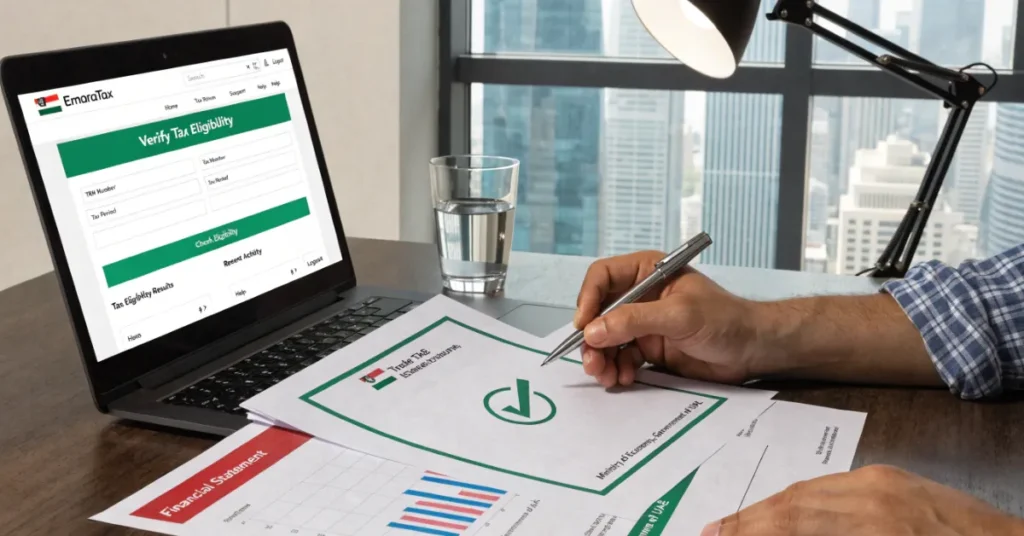
Not every business automatically receives this relief; you must actively elect it when filing your tax return. But before that, you need to confirm whether you meet the eligibility criteria.
Eligibility criteria
- Annual revenue must not exceed AED 3 million for the relevant tax period (subject to updates by the Ministry of Finance)
- The business must be a UAE tax resident, meaning incorporated or effectively managed in the UAE
- Proper financial records must be maintained for the tax period in question
- The business must actively elect the relief within its corporate tax return; it is not applied automatically
Who is not eligible?
- Large enterprises with revenue exceeding the AED 3 million threshold
- Businesses that are part of a multinational group are subject to Pillar Two (global minimum tax) rules
- Companies that exceed the revenue cap at any point during the relevant tax period
- Qualifying free zone persons who are already subject to special tax treatment
Key benefits of business tax relief for SMEs
For businesses that qualify, the advantages go beyond just saving money on a tax bill. The relief fundamentally changes how your business interacts with corporate tax obligations.
- Reduced compliance burden: You do not need to calculate taxable income or prepare a full tax computation
- No corporate tax liability: Qualifying businesses effectively pay zero tax, even if they are profitable
- Lower accounting and advisory costs: Simplified filing means less time and money spent on professional fees
- Encourages startups: Early-stage businesses can focus on growth rather than tax obligations during critical first years
- Improved cash flow: Keeping profits within the business rather than paying tax on them directly supports reinvestment and operations
For a business earning AED 2 million annually, this relief could mean retaining funds that would otherwise be tied up in compliance and potential tax exposure. That is meaningful capital for a growing SME.
How to apply for UAE small business tax relief
The process is managed entirely through the Federal Tax Authority’s EmaraTax portal. It is not complicated, but it does require that certain steps be completed correctly and on time.
Step-by-step process
- Register for corporate tax with the FTA via the EmaraTax platform if you have not already done so
- Maintain accurate financial records throughout your tax period; revenue figures will be scrutinized.
- When preparing your annual corporate tax return, elect Small Business Relief in the relevant section
- Submit your tax return by the deadline (generally nine months after the end of your financial year)
Documents required
- Valid UAE trade license
- Financial statements covering the tax period
- Revenue documentation (invoices, bank statements, or accounting records)
- Tax Registration Number (TRN) from the FTA
Common mistakes to avoid when claiming tax relief

- Missing revenue threshold updates: The AED 3 million cap could be revised, check FTA announcements annually
- Poor bookkeeping: Revenue figures must be accurately documented; estimates or incomplete records create audit risk
- Late tax registration: Failing to register with the FTA on time can result in penalties, regardless of your relief eligibility
- Forgetting to elect the relief: It must be actively selected in your return; silence does not equal consent
- Assuming free zone status automatically qualifies: Free zone businesses face separate conditions under the qualifying income rules
Consequences of getting these wrong can include administrative penalties, back taxes, and increased scrutiny in future tax periods. The FTA does conduct audits, and businesses relying on relief without proper documentation are particularly exposed.
Free zone vs mainland: does tax relief apply?
This is one of the most commonly misunderstood areas of UAE corporate tax. Small Business Relief is available to mainland companies that meet the revenue and residency criteria. Free zone businesses, however, operate under a different framework.
Free zone entities can benefit from a 0% tax rate on qualifying income, but they must meet strict conditions around substance, activities, and the nature of their transactions. If a free zone business earns non-qualifying income, that portion may be taxed at 9%.
Importantly, a free zone business that elects Small Business Relief may forfeit its free zone tax benefits. If you operate in a free zone, you should review both regimes carefully before deciding which applies to your situation, ideally with professional guidance.
Record-keeping requirements for UAE SMEs
Whether you claim relief or not, maintaining proper records is a legal requirement under UAE corporate tax law. The FTA expects businesses to be audit-ready at all times.
- All financial records must be retained for a minimum of seven years (not five, as recent FTA guidance aligns with international standards)
- Revenue must be tracked accurately across all income streams
- Use accounting software (such as Xero, QuickBooks, or locally compliant platforms) to maintain structured records
- Keep copies of invoices, contracts, bank statements, and any documents supporting revenue figures
How business tax relief impacts startups in 2026
For early-stage businesses in the UAE, Small Business Relief is more than a tax provision; it is a meaningful policy signal. The UAE government has consistently positioned the country as a global startup hub, and this relief supports that ambition practically.
Startups in their first two to three years usually do not generate profits that would attract significant tax liability anyway. But the compliance side registration, filing, and record-keeping can still create pressure on lean teams. The relief removes the calculation burden and gives founders one less administrative obstacle during the critical growth phase. It also makes the UAE more attractive for entrepreneurs relocating or incorporating for the first time.
Future updates and changes to watch
The UAE’s corporate tax framework is still relatively new, and businesses should expect refinements over time. Three areas in particular are worth monitoring in 2026 and beyond:
- Revenue threshold adjustments: The AED 3 million cap may be revised as the FTA gathers data on SME compliance patterns. Both upward and downward adjustments are possible.
- Increased compliance requirements: As corporate tax matures, the FTA is expected to tighten documentation standards and expand its audit scope. Businesses that have relied on simplified relief may face stricter scrutiny.
- Global minimum tax alignment: The UAE has committed to implementing the OECD’s Pillar Two framework for large multinationals. While small businesses are not directly affected, the broader tax environment will become more complex, and SMEs in the supply chains of large groups should be aware of indirect implications.
When should you seek professional tax advice?
- Your annual revenue is approaching AED 3 million, and you need to understand what happens if you cross the threshold mid-year
- Your business has multiple revenue streams, subsidiaries, or related-party transactions that complicate simple revenue calculations
- You operate in a free zone and are unsure whether to elect relief or preserve your qualifying income status
- You have not yet registered for corporate tax and are unsure of your obligations
- You are restructuring, expanding, or bringing in investors, any of which can change your tax position materially
How Ripple Business Setup Can Help You Access UAE Small Business Tax Relief
Navigating UAE corporate tax rules can feel confusing, especially for small business owners. Ripple Business Setup offers practical support to help you understand and apply for Business Tax Relief without stress. Their team assists with corporate tax registration, eligibility assessment, bookkeeping setup, and accurate tax filing, so you stay compliant with UAE laws. Whether you are a startup or an SME, getting expert guidance can save time and reduce costly mistakes. To get started, contact Ripple Business Setup at +971 50 593 8101, email info@ripplellc.ae, or WhatsApp +971 4 250 0833 for quick assistance.
Conclusion
For most small businesses operating in the UAE with revenues below AED 3 million, Small Business Relief is a straightforward and valuable provision. It reduces your tax liability to zero, simplifies your annual filing, and lets you focus on building your business rather than managing a complex compliance process.
Disclaimer: This content is for general informational purposes only and does not constitute legal or tax advice. Tax regulations in the UAE may change, and eligibility depends on individual business circumstances. It is recommended to consult qualified tax professionals or advisors before making any financial or legal decisions.