
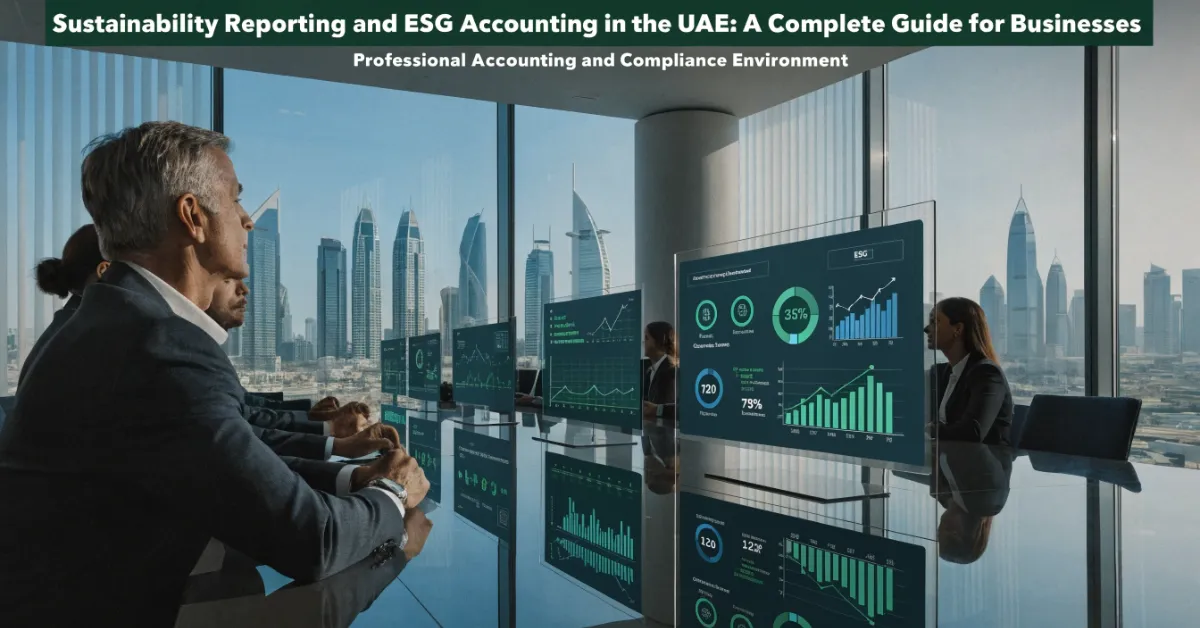
Sustainability reporting and ESG accounting are becoming essential business practices across the UAE. As investors, regulators, customers, and stakeholders place greater emphasis on environmental and social responsibility, organizations are expected to demonstrate how they manage sustainability risks and opportunities.
The UAE has positioned itself as a regional leader in sustainable development through initiatives such as the UAE Net Zero 2050 Strategic Initiative, sustainable finance frameworks, and green economic policies. As a result, businesses operating in the country are increasingly integrating Environmental, Social, and Governance (ESG) principles into their operations and reporting processes.
What is Sustainability Reporting?
Sustainability reporting is the process of disclosing an organization’s environmental, social, and governance performance. Unlike traditional financial reports that focus solely on profits and losses, sustainability reports provide stakeholders with insights into how a company impacts society and the environment.
Businesses use sustainability reporting to communicate their progress toward sustainability goals, identify risks, and demonstrate accountability.
Key areas commonly covered in sustainability reports include:
- Carbon emissions and climate impact
- Energy consumption
- Waste management
- Water conservation
- Employee wellbeing
- Diversity and inclusion
- Corporate governance practices
- Community engagement initiatives
Sustainability reporting helps companies build trust, improve decision-making, and meet growing stakeholder expectations.
Understanding ESG Accounting and Why It Matters
ESG accounting refers to the process of measuring, tracking, and reporting ESG-related data using structured accounting principles and methodologies.
Traditional accounting focuses on financial performance. ESG accounting expands this approach by incorporating non-financial factors that can significantly affect business value and long-term sustainability.
Organizations use ESG accounting to:
- Track sustainability performance
- Measure climate-related risks
- Monitor governance practices
- Evaluate social impact
- Improve transparency for investors
Businesses with strong ESG performance often enjoy better access to investment opportunities, enhanced reputation, and improved risk management.
The Three Pillars of ESG
Environmental (E)
Environmental factors assess how a company manages its impact on the natural environment.
Examples include:
- Greenhouse gas emissions
- Energy efficiency
- Renewable energy adoption
- Waste reduction programs
- Water conservation efforts
Social (S)
Social factors evaluate how a company interacts with employees, customers, suppliers, and communities.
Examples include:
- Employee welfare programs
- Workplace health and safety
- Diversity and inclusion initiatives
- Human rights policies
- Community engagement activities
Governance (G)
Governance focuses on how a company is managed and controlled.
Examples include:
- Board independence
- Ethical business conduct
- Risk management systems
- Anti-corruption policies
- Regulatory compliance procedures
Together, these three pillars provide a comprehensive view of a company’s sustainability performance.
Why ESG Reporting is Becoming Essential in the UAE
The UAE is actively promoting sustainable economic development. Government initiatives and international commitments are encouraging businesses to adopt ESG practices and improve transparency.
Several factors are driving ESG adoption across the UAE:
Growing Investor Expectations
Investors increasingly evaluate ESG performance when making investment decisions. Companies with strong ESG disclosures often attract more institutional investors and funding opportunities.
UAE Net Zero 2050 Initiative
The UAE became the first country in the Middle East to announce a strategic initiative aimed at achieving net-zero emissions by 2050. This commitment is encouraging organizations to monitor and report environmental performance more accurately.
Increased Regulatory Attention
Regulators and financial authorities are gradually strengthening sustainability disclosure requirements. Businesses that prepare early will be better positioned for future compliance obligations.
Competitive Advantage
Organizations with transparent ESG reporting can differentiate themselves from competitors, strengthen brand reputation, and build customer trust.
Sustainability Reporting Requirements in the UAE
While ESG reporting requirements continue to evolve, many organizations are already expected to provide sustainability-related disclosures.
Businesses most likely to engage in ESG reporting include:
- Publicly listed companies
- Financial institutions
- Government-linked entities
- Large corporations
- Multinational organizations
- Businesses seeking international investors
Common disclosure areas include:
- Carbon emissions
- Energy consumption
- Climate-related risks
- Workforce diversity
- Governance structures
- Sustainability targets
- Supply chain practices
Companies that establish reporting systems today can adapt more easily as regulatory expectations expand.
Major Sustainability Reporting Frameworks Used in the UAE
Choosing the right reporting framework is essential for creating credible sustainability reports.
IFRS Sustainability Disclosure Standards (ISSB)
The International Sustainability Standards Board (ISSB) has developed globally recognized sustainability disclosure standards that help investors assess sustainability-related risks and opportunities.
Many UAE organizations are exploring ISSB adoption to align with international reporting expectations.
Global Reporting Initiative (GRI)
GRI is one of the most widely used sustainability reporting frameworks globally.
The framework focuses on stakeholder transparency and provides detailed guidance for reporting environmental, social, and governance impacts.
GRI is commonly used by organizations seeking comprehensive sustainability reporting.
Sustainability Accounting Standards Board (SASB)
SASB provides industry-specific reporting standards that help companies identify financially material sustainability issues.
The framework is particularly valuable for investors who want comparable ESG information across industries.
Task Force on Climate-Related Financial Disclosures (TCFD)
TCFD focuses on climate-related risks and opportunities.
It helps businesses disclose:
- Climate governance
- Risk management processes
- Strategic impacts
- Climate-related metrics and targets
Many organizations integrate TCFD recommendations into broader ESG reporting strategies.
Integrated Reporting Framework
Integrated reporting combines financial and non-financial information into a single report.
This approach provides stakeholders with a holistic understanding of how sustainability factors contribute to long-term value creation.
How ESG Accounting Works in Practice
Implementing ESG accounting requires a structured approach.
Step 1: Identify Material ESG Issues
Companies must determine which sustainability issues have the greatest impact on their business and stakeholders.
Step 2: Collect ESG Data
Organizations gather information from various departments, including finance, operations, HR, procurement, and sustainability teams.
Step 3: Measure ESG Performance
Businesses calculate relevant metrics such as emissions, energy usage, employee turnover, and governance indicators.
Step 4: Verify Data Accuracy
Accurate ESG reporting requires robust internal controls and verification procedures.
Step 5: Prepare Sustainability Reports
The collected data is organized according to selected reporting frameworks and disclosed to stakeholders in a transparent manner.
Common ESG Metrics UAE Businesses Should Track

Measuring ESG performance requires organizations to monitor meaningful and consistent indicators. These metrics help businesses evaluate progress, identify improvement opportunities, and communicate results to stakeholders.
Environmental Metrics
Environmental metrics focus on resource usage and environmental impact.
Key examples include:
- Greenhouse gas emissions (Scope 1, 2, and 3)
- Energy consumption
- Renewable energy usage
- Water consumption
- Waste generation and recycling rates
- Carbon footprint reduction
- Air pollution levels
Social Metrics
Social indicators measure how businesses manage relationships with employees, customers, and communities.
Common social metrics include:
- Employee retention rates
- Workforce diversity
- Employee training hours
- Workplace injury rates
- Employee satisfaction scores
- Community investment initiatives
- Customer satisfaction ratings
Governance Metrics
Governance metrics evaluate leadership effectiveness and accountability.
Examples include:
- Board diversity
- Board independence
- Regulatory compliance incidents
- Anti-corruption training completion
- Internal audit findings
- Risk management effectiveness
- Ethics and whistleblowing reports
Tracking these ESG KPIs enables businesses to make informed decisions and demonstrate measurable progress toward sustainability goals.
Benefits of Sustainability Reporting and ESG Accounting
Organizations that implement sustainability reporting and ESG accounting often experience significant operational, financial, and strategic advantages.
Financial Benefits
Investors increasingly favor businesses with strong ESG performance. Transparent sustainability reporting can improve investor confidence and enhance access to capital.
Additional financial benefits include:
- Improved financing opportunities
- Better risk management
- Reduced compliance costs
- Increased investor interest
Operational Benefits
ESG initiatives often reveal opportunities to improve efficiency and reduce waste.
Operational benefits include:
- Lower energy consumption
- Reduced resource waste
- Improved supply chain management
- Enhanced employee productivity
Strategic Benefits
Strong ESG performance can strengthen a company’s market position.
Key advantages include:
- Enhanced brand reputation
- Greater customer trust
- Increased stakeholder confidence
- Competitive differentiation
Businesses that prioritize ESG often gain long-term resilience and sustainable growth.
Challenges Companies Face When Implementing ESG Reporting
Despite its benefits, ESG reporting can present several challenges.
Lack of ESG Expertise
Many organizations struggle to understand reporting frameworks, sustainability metrics, and disclosure requirements.
Data Collection Difficulties
ESG data often comes from multiple departments and systems. Gathering accurate information can be time-consuming.
Evolving Regulations
Sustainability reporting standards continue to evolve globally, requiring businesses to stay updated on changing requirements.
Technology Limitations
Organizations using manual reporting processes may face inefficiencies and increased risk of reporting errors.
Cost Concerns
Implementing ESG systems, software, and reporting processes may require initial investments.
How Businesses Can Overcome These Challenges
Organizations can improve ESG reporting by:
- Investing in ESG software solutions
- Establishing clear reporting processes
- Training employees on ESG principles
- Engaging professional advisors
- Conducting regular sustainability audits
- Automating data collection where possible
Taking a proactive approach helps businesses build a reliable ESG reporting framework.
ESG Reporting Trends Shaping the UAE Market in 2026 and Beyond

The sustainability landscape is evolving rapidly, and UAE businesses are expected to face increasing expectations from investors, regulators, and customers.
AI-Powered ESG Reporting
Artificial intelligence is transforming ESG data collection, analysis, and reporting. Automated systems can improve efficiency while reducing reporting errors.
Real-Time Sustainability Dashboards
Organizations are moving beyond annual reports and adopting dashboards that provide real-time sustainability performance tracking.
Carbon Accounting Adoption
As climate-related disclosures become more important, businesses are increasingly implementing carbon accounting systems to measure emissions accurately.
Growth of Sustainable Finance
Banks and investors are expanding sustainable financing options for businesses with strong ESG credentials.
Supply Chain ESG Monitoring
Companies are expected to assess sustainability performance throughout their supply chains, not just within their own operations.
Increased Regulatory Expectations
Future regulations are likely to require more comprehensive and standardized ESG disclosures.
Businesses that prepare now will be better positioned to meet future reporting requirements.
Case Example: Building an ESG Reporting Framework in the UAE
Consider a mid-sized manufacturing company based in Dubai.
The company wanted to improve operational efficiency, attract investors, and align with sustainability objectives.
Initial Assessment
Management conducted an ESG assessment to identify material sustainability issues.
The assessment highlighted:
- High energy consumption
- Limited emissions tracking
- Lack of formal ESG reporting
- Opportunities for employee engagement programs
Actions Implemented
The company introduced several initiatives:
- Carbon emissions monitoring
- Energy efficiency upgrades
- Employee wellness programs
- Enhanced governance controls
- Sustainability reporting procedures
Results Achieved
Within two years, the organization experienced:
- Reduced operational costs
- Improved investor confidence
- Better regulatory preparedness
- Stronger employee engagement
- Enhanced brand reputation
This example demonstrates how ESG reporting can create measurable business value while supporting sustainability goals.
Best Practices for Effective Sustainability Reporting
Organizations can improve reporting quality by following established best practices.
Focus on Material Issues
Report on sustainability topics that are most relevant to the business and stakeholders.
Set Measurable Goals
Establish clear targets that can be monitored and evaluated over time.
Use Recognized Frameworks
Adopt globally accepted standards such as GRI, ISSB, SASB, or TCFD.
Maintain Consistency
Use consistent methodologies to ensure reliable year-over-year comparisons.
Verify ESG Data
Implement strong internal controls and verification processes.
Engage Stakeholders
Gather feedback from investors, employees, customers, and business partners.
Continuously Improve
Treat sustainability reporting as an ongoing process rather than a one-time exercise.
How Professional Accounting Firms Support ESG Compliance
Professional accounting firms play an increasingly important role in helping organizations manage ESG reporting requirements.
Their services often include:
- ESG readiness assessments
- Sustainability reporting preparation
- ESG data collection support
- Carbon accounting assistance
- Internal control evaluations
- Regulatory compliance guidance
- ESG performance measurement
By leveraging professional expertise, businesses can improve reporting accuracy, strengthen compliance, and align with global best practices.
Why Choose Ripple Business Setup for ESG Accounting and Sustainability Reporting Support
As sustainability reporting becomes increasingly important in the UAE, businesses need reliable guidance to navigate ESG requirements, reporting frameworks, and compliance expectations.
Ripple Business Setup provides professional support for organizations seeking to strengthen their ESG reporting capabilities and sustainability strategies. Their experienced team helps businesses establish reporting frameworks, improve accounting processes, enhance compliance readiness, and align sustainability initiatives with long-term business objectives.
Whether your organization is preparing its first sustainability report or looking to improve existing ESG disclosures, professional support can simplify implementation and improve reporting accuracy.
Contact Ripple Business Setup
- Phone: +971 50 593 8101
- WhatsApp: +971 4 250 0833
- Email: info@ripplellc.ae
Frequently Asked Questions
What is ESG accounting?
ESG accounting is the process of measuring, tracking, and reporting environmental, social, and governance data alongside traditional financial information.
Is ESG reporting mandatory in the UAE?
Requirements vary depending on company type, industry, and regulatory obligations. However, ESG reporting expectations are increasing across the UAE.
Which ESG framework is best for UAE businesses?
Many organizations use GRI, ISSB, SASB, or TCFD frameworks depending on their industry, stakeholders, and reporting objectives.
How often should sustainability reports be published?
Most companies publish sustainability reports annually, although some provide more frequent ESG updates.
What are the benefits of ESG reporting?
Benefits include stronger investor confidence, improved risk management, enhanced reputation, operational efficiencies, and better regulatory preparedness.
Can SMEs implement ESG practices?
Yes. Small and medium-sized businesses can begin with basic ESG initiatives and gradually expand reporting as their sustainability programs mature.
What ESG metrics should companies prioritize?
Companies should focus on material metrics related to environmental impact, employee wellbeing, governance practices, and stakeholder expectations.
How does ESG reporting attract investors?
Investors increasingly seek transparent organizations that effectively manage sustainability risks and opportunities. Strong ESG reporting demonstrates accountability and long-term value creation.
Conclusion
Sustainability reporting and ESG accounting are no longer optional considerations for forward-thinking businesses in the UAE. As investor expectations, regulatory requirements, and stakeholder demands continue to evolve, organizations that embrace ESG principles gain a significant competitive advantage.
Disclaimer: This article is for informational purposes only and should not be considered legal, financial, accounting, or ESG compliance advice. Regulations and reporting requirements may change over time. Businesses should consult qualified professionals for advice tailored to their specific circumstances.